Northern lights forecast · tonight
Northern Lights Forecast for Tonight:
Aurora Tracker
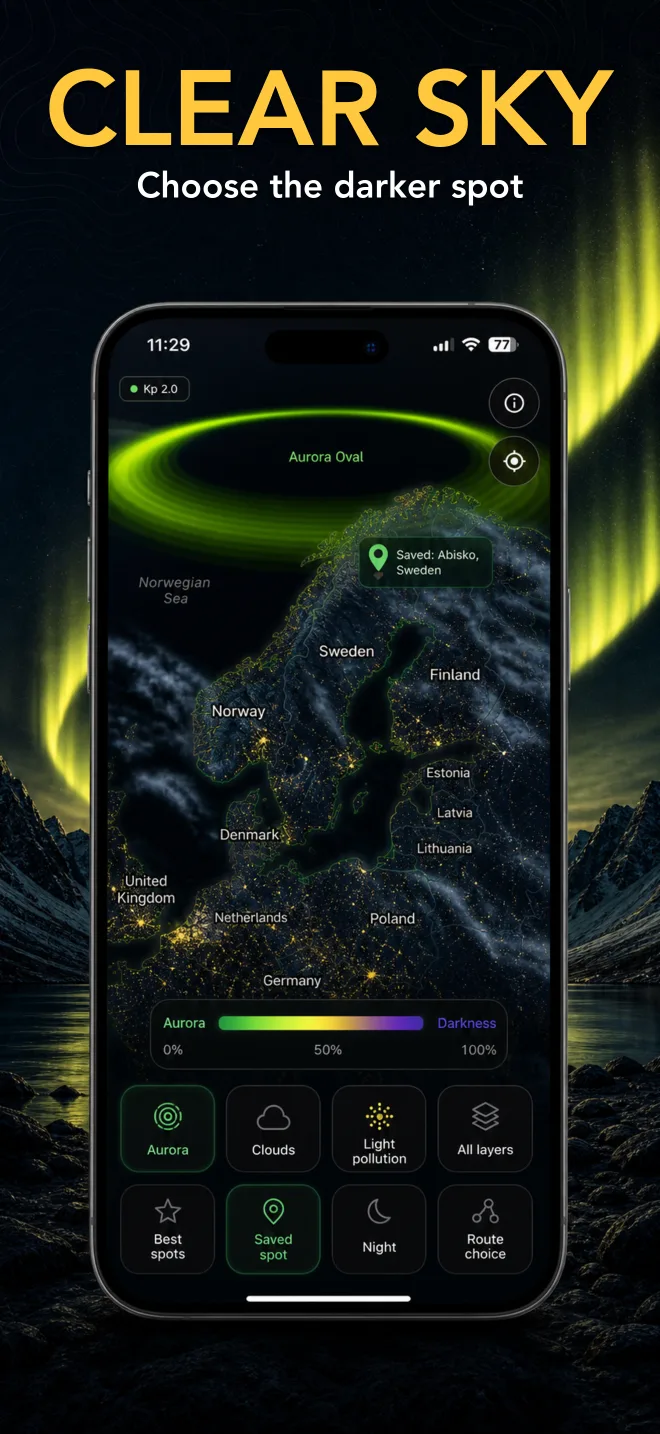
Know when to go out. Local aurora forecasts and free alerts, wherever you are.
Free to download · iOS & Android


Check your city’s forecast
Free24h forecast · 1 location · 4 alert types
Premium72h + 27-day forecast · unlimited locations · 14 alert types
Take the forecast with you
Live Aurora Conditions
Global Kp Index
-- Kp
Loading aurora conditions...
Solar Wind
--
km/s
--
p/cm³
Loading...
Bz Field
-- nT
Loading magnetic field data...
Kp Index: 27-Day Forecast
Kp 5+ Kp 3-4 Kp 1-2
Popular forecast hubs right now: aurora forecast Rovaniemi, aurora forecast Tromso, aurora forecast Stockholm, aurora forecast Helsinki, northern lights forecast New York, aurora forecast Ontario, and aurora forecast Sweden.
Need the broad view first? Aurora borealis forecast, northern lights tonight, live aurora tracker, and aurora app comparisons.
Want a head-to-head breakdown? Browse every AuroraMe vs competitor comparison or start with AuroraMe vs My Aurora Forecast.
Aurora Destinations by Country
🇺🇸
United States
304 locations 🇨🇦
Canada
73 locations 🇷🇺
Russia
35 locations 🇳🇴
Norway
29 locations 🇫🇮
Finland
29 locations 🇸🇪
Sweden
24 locations 🇬🇧
United Kingdom
23 locations 🇬🇱
Greenland
20 locations 🇩🇰
Denmark
16 locations 🇯🇵
Japan
14 locations 🇮🇸
Iceland
12 locations 🇱🇹
Lithuania
12 locations 🇳🇱
Netherlands
12 locations 🇩🇪
Germany
12 locations 🇵🇱
Poland
12 locations 🇧🇾
Belarus
12 locationsShow all 53 countries
🇫🇷
France
12 locations 🇺🇦
Ukraine
12 locations 🇮🇹
Italy
12 locations 🇪🇸
Spain
12 locations 🇨🇱
Chile
12 locations 🇿🇦
South Africa
12 locations 🇳🇿
New Zealand
11 locations 🇦🇺
Australia
11 locations 🇦🇷
Argentina
11 locations 🇮🇪
Ireland
10 locations 🇪🇪
Estonia
10 locations 🇱🇻
Latvia
10 locations 🇧🇪
Belgium
10 locations 🇱🇺
Luxembourg
10 locations 🇨🇿
Czech Republic
10 locations 🇨🇭
Switzerland
10 locations 🇸🇰
Slovakia
10 locations 🇦🇹
Austria
10 locations 🇭🇺
Hungary
10 locations 🇸🇮
Slovenia
10 locations 🇭🇷
Croatia
10 locations 🇷🇴
Romania
10 locations 🇵🇹
Portugal
10 locations 🇷🇸
Serbia
10 locations 🇧🇦
Bosnia and Herzegovina
10 locations 🇫🇰
Falkland Islands
10 locations 🇲🇪
Montenegro
10 locations 🇧🇬
Bulgaria
10 locations 🇦🇱
Albania
10 locations 🇲🇰
North Macedonia
10 locations 🇲🇳
Mongolia
10 locations 🇬🇷
Greece
10 locations 🇲🇹
Malta
10 locations 🇨🇾
Cyprus
10 locations 🇺🇾
Uruguay
10 locations 🇧🇷
Brazil
10 locations 🇬🇸
South Georgia
9 locationsFrequently Asked Questions
What is the Kp index?
The Kp index measures geomagnetic activity on a scale from 0 to 9, published by NOAA SWPC every 3 hours. Higher Kp means a larger auroral oval and aurora visible at lower latitudes. Kp 3+ is visible in northern Scandinavia, Kp 5+ reaches Scotland and northern US states, Kp 7+ can reach central Europe.
Can I see aurora tonight?
Aurora visibility depends on 5 factors: Kp index (geomagnetic activity), cloud cover, moon phase, hours of darkness, and your magnetic latitude. All five must align — even strong Kp activity is invisible behind clouds or during twilight. Check the forecast for your city to see if conditions align tonight.
What causes the northern lights?
Aurora borealis occurs when charged particles from the solar wind enter Earth's magnetosphere and collide with atmospheric gases. Oxygen produces green light (90–150 km altitude) and red light (above 200 km), while nitrogen creates purple and blue hues. Coronal mass ejections (CMEs) from the Sun trigger the strongest displays.
How does aurora forecasting work?
AuroraMe uses a 5-factor prediction model: real-time Kp index from NOAA SWPC, local cloud cover forecasts, moon phase and illumination, hours of darkness at your location, and magnetic latitude (which determines your minimum Kp threshold). These factors are combined into a single visibility status updated every 15 minutes.
When is the best time to see the northern lights?
The best season is September through March in the northern hemisphere, with peak activity around the equinoxes (September-October, February-March) due to the Russell-McPherron effect. The best hours are 10 PM to 2 AM local time, when geomagnetic substorms peak. Solar Cycle 25 is near its maximum in 2025-2026, making this period exceptionally active.
What Kp level do I need for my location?
Your required Kp depends on magnetic latitude. The formula is roughly: Required Kp = (66 - Magnetic Latitude) / 2. For example, Tromsø (67.4° MLAT) needs just Kp 1, Edinburgh (58.2° MLAT) needs Kp 4, and London (53.4° MLAT) needs Kp 6. Check any city page for the exact Kp threshold calculated from its magnetic latitude.