How to Check Aurora Visibility: Kp, Clouds & Darkness
Three checks before you head out: Kp for your latitude, cloud cover to the north, and full darkness — plus what cloudy weather and moonlight do to aurora.
Looking for the live status? Check northern lights tonight for current Kp, solar wind data, and city-by-city forecasts.
Quick Answer: Can You See Aurora Tonight?
To see northern lights tonight, you need three things to align:
The fastest way to check? Download AuroraMe app for iOS or Android for real-time aurora forecast combining all three factors + instant alerts when conditions are perfect.
What is Aurora Activity (Kp)? (Simple Explanation)
Aurora Activity (Kp) measures geomagnetic activity on a scale of 0-9. Think of it as the "aurora strength". For a full breakdown, see our detailed Aurora Activity guide.
- Kp 0-2: Quiet conditions — aurora only visible at polar latitudes (Fairbanks, Reykjavík, Tromsø)
- Kp 3-5: Moderate activity — aurora visible in Northern US, Canada, Scotland (Anchorage, Yellowknife, Aberdeen)
- Kp 6-9: Strong geomagnetic storm — aurora visible as far south as London, New York, or even lower latitudes
💡 Important: Your Location Matters
A Kp 3 storm in Alaska means aurora overhead. The same Kp 3 in Scotland means nothing visible. This is why generic Kp forecasts don't work — you need location-specific thresholds.
How Kp Requirements Change by Latitude
Here's what Kp index you need based on your magnetic latitude (MLAT):
Quiet
Visible Here
Extreme Storm
Example: Location requires Kp 5+ to see aurora. Current Kp 3 = not visible (red zone).
| Location Example | Magnetic Latitude | Required Kp | Frequency |
|---|---|---|---|
| Fairbanks, Alaska | 65° | Kp 2 | 100+ nights/year |
| Tromsø, Norway | 67° | Kp 2 | 200+ nights/year |
| Reykjavik, Iceland | 64° | Kp 2 | 80+ nights/year |
| Seattle, USA | 54° | Kp 5 | 5-10 nights/year |
| Edinburgh, Scotland | 58° | Kp 6 | 3-7 nights/year |
| London, UK | 53° | Kp 7 | 1-3 nights/year |
Key takeaway: Don't just check "Kp index" — check if current Kp meets your location's threshold. AuroraMe does this calculation automatically for 1,000+ cities.
Why Weather Matters (Even with High Kp)
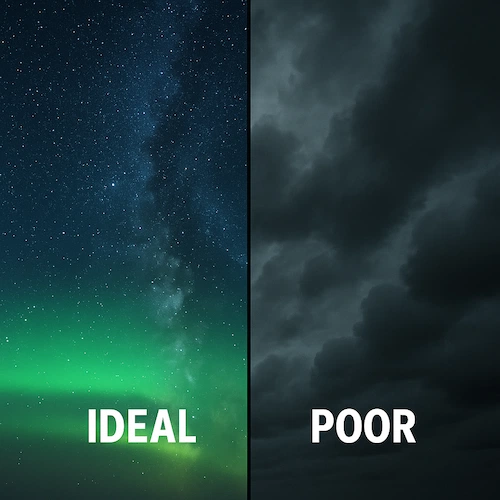
You can have a Kp 9 geomagnetic superstorm, but if there are clouds above you, you'll see nothing. Aurora happens 60-300 miles above Earth — clouds at 1-2 miles altitude completely block the view.
What Cloud Coverage Means
- 0-20% clouds: Perfect conditions — clear view of aurora
- 20-50% clouds: Partially visible — you might see aurora through gaps
- 50-80% clouds: Mostly obscured — brief glimpses only
- 80-100% clouds: Completely blocked — go back inside
Pro tip: Use live weather radar to find gaps in clouds. Sometimes driving 20-30 minutes to a clear patch makes the difference between seeing aurora or not.
⚠️ Moon Phase Also Impacts Visibility
Full moon creates "light pollution" that washes out faint aurora. Best viewing: new moon (0% illumination) or during moon-free hours (after moonset, before moonrise). Strong aurora (Kp 6+) are still visible with full moon, but faint displays disappear.
What Time Should I Go Outside?
Aurora is visible only in complete darkness. This means:
- Not during twilight — Even dim "blue hour" light washes out aurora
- Not during summer — Locations above 60°N have 24-hour daylight in June/July
- Best hours: 10 PM – 2 AM local time — Statistical peak for aurora activity
Tonight's Optimal Viewing Window
The best time varies by season and latitude. In general:
| Season | Darkness Hours | Best Window |
|---|---|---|
| Winter (Dec-Feb) | 6 PM – 6 AM | 10 PM – 3 AM |
| Spring/Fall (Mar-May, Sep-Nov) | 8 PM – 5 AM | 10 PM – 2 AM |
| Summer (Jun-Aug) | Limited/None (above 60°N) | Not viable |
Important: Aurora can appear anytime during darkness hours. The "10 PM – 2 AM" window is just statistically most active. If Kp is high and skies are clear at 9 PM, go outside immediately — don't wait for "the perfect time."
How to Check If Northern Lights Are Visible Tonight
Here's the step-by-step process to determine if you'll see aurora tonight:
Method 1: Use AuroraMe App (Recommended)
- Download AuroraMe app for iOS or Android (free)
- Add your location (or check forecasts for Fairbanks, Tromsø, Reykjavík, and 1,000+ other cities)
- Check the "Tonight" forecast showing:
- Enable notifications to get alerts when conditions improve (see our aurora alerts setup guide for best practices)
Method 2: Manual Forecast Check
If you prefer checking manually, combine these sources:
- Kp forecast: NOAA Space Weather Prediction Center — 3-day Kp forecast
- Cloud forecast: Check local weather for cloud coverage
- Moon phase: Full moon washes out faint aurora displays
- Darkness hours: Aurora only visible after complete darkness (nautical twilight)
- Calculate if Kp meets your threshold — See table above or use our aurora forecast tracker guide
❌ Don't Rely on Generic "Aurora Tonight" Forecasts
Many websites show "aurora forecast maps" with green ovals. These are OVATION model predictions for 60-100 km altitude. They don't account for:
- Your local clouds
- Moon phase
- Darkness hours
- Actual visibility from ground level
A green OVATION oval doesn't guarantee visibility. Always cross-check with weather and darkness.
Where Can I See Northern Lights Tonight?
Best locations for aurora viewing tonight depend on current Kp index:
Kp 0-2 (Quiet Conditions)
Only visible in polar regions:
- Northern Norway (Tromsø, Alta, Svalbard)
- Alaska (Fairbanks, Barrow, Nome)
- Greenland
- Northern Canada (Yellowknife, Iqaluit, Whitehorse)
Kp 3-5 (Moderate Activity)
Visible in aurora zones + Northern regions:
- Iceland (Reykjavik, entire island)
- Finland (Rovaniemi, Inari, Ivalo)
- Sweden (Abisko, Kiruna, Jokkmokk)
- Scotland (Highlands, Shetland Islands)
- Northern US (Montana, Minnesota, North Dakota, Michigan Upper Peninsula)
- Canada (most provinces above 50°N)
Kp 6-9 (Geomagnetic Storm)
Visible as far south as:
- London, UK
- Berlin, Germany
- Seattle, Portland, Minneapolis (USA)
- Toronto, Quebec City (Canada)
- Copenhagen, Denmark
Check live forecasts for your specific city on AuroraMe homepage — we track aurora visibility for 1,023 cities worldwide.
5 Mistakes Beginners Make (And How to Avoid Them)
1. Checking Only Kp Index
Mistake: "Kp is 5 tonight, I'll definitely see aurora!"
Reality: Clouds can be 100%, moon can be full, or it's still twilight. Always check all three factors.
2. Waiting for "Perfect" Kp 9 Storms
Mistake: "I'll only go out when there's a huge storm."
Reality: Kp 9 storms happen 2-3 times per solar cycle (11 years). If you live above 60°N, Kp 2-3 displays are spectacular and frequent.
3. Going Outside During Twilight
Mistake: Checking at 8 PM when there's still a blue glow in the sky.
Reality: Wait for full darkness (nautical twilight ends). Aurora is there, but invisible in twilight.
4. Staying in City Centers
Mistake: Watching from a well-lit street or downtown area.
Reality: Light pollution washes out faint aurora. Drive 15-30 minutes outside city limits for dark skies.
5. Giving Up After 10 Minutes
Mistake: "I looked for 10 minutes, saw nothing, went back inside."
Reality: Aurora activity fluctuates. Stay outside for 30-60 minutes during favorable conditions. Many displays start faint and intensify over time.
Frequently Asked Questions
How accurate are northern lights forecasts?
Short-term aurora forecasts are more useful than long-range outlooks, but they remain estimates. NOAA OVATION updates frequently from real-time solar-wind data. Cloud cover, timing, and aurora intensity can still differ from the forecast. AuroraMe combines these inputs into an Aurora Score for local viewing conditions, not a guarantee.
Can I see aurora with my eyes or only with a camera?
Yes, you can see it with naked eyes — if conditions are right. Faint displays (Kp 2-3) appear as pale green "clouds" or pillars. Strong displays (Kp 5+) show vivid green, pink, purple colors dancing across the sky. Cameras pick up more color due to long exposures, but naked-eye aurora during storms is spectacular.
What if forecast says "maybe" or "low chance"?
Go outside anyway if you can. The Aurora Score is a heuristic estimate of local viewing conditions, not a calibrated probability or guarantee. Unexpected displays can still happen. In the AuroraMe app, choose the viewing-status level you want alerts for.
Is winter better than summer for aurora?
Winter has more viewing hours due to long darkness (6 PM – 6 AM vs. summer's limited darkness). However, geomagnetic activity has no seasonal pattern — Kp storms happen year-round. The issue is darkness, not aurora frequency. In summer above 60°N, you have "white nights" with no aurora visibility.
How long do northern lights displays last?
From 15 minutes to several hours. Brief "substorms" last 30-60 minutes. Major geomagnetic storms (Kp 6+) can produce aurora for 4-6 hours with breaks. The "dancing" phase (rapid movement) typically lasts 5-20 minutes within longer displays.
Sources
- NOAA SWPC — Planetary K-index — real-time geomagnetic activity data
- NOAA SWPC — OVATION Aurora Forecast — 30-minute aurora probability model
- NOAA SWPC — 3-Day Forecast — official short-term Kp predictions
- NOAA NCEI — Magnetic Field Calculator — IGRF-based magnetic latitude lookup
- AuroraMe Methodology — our 5-factor prediction algorithm explained
Start Tracking Northern Lights Tonight
Don't miss the next promising aurora window. AuroraMe combines Kp index, cloud forecasts, moon phase, and darkness into an Aurora Score for local viewing conditions. The score is a heuristic estimate, not a guarantee. Free 3-day forecast + instant alerts.

