Rastreador de Auroras Boreales
Rastree la visibilidad de la aurora en 1023 ubicaciones. KP actual 2.0 — actividad débil. Incluye nubes, fase lunar y oscuridad.
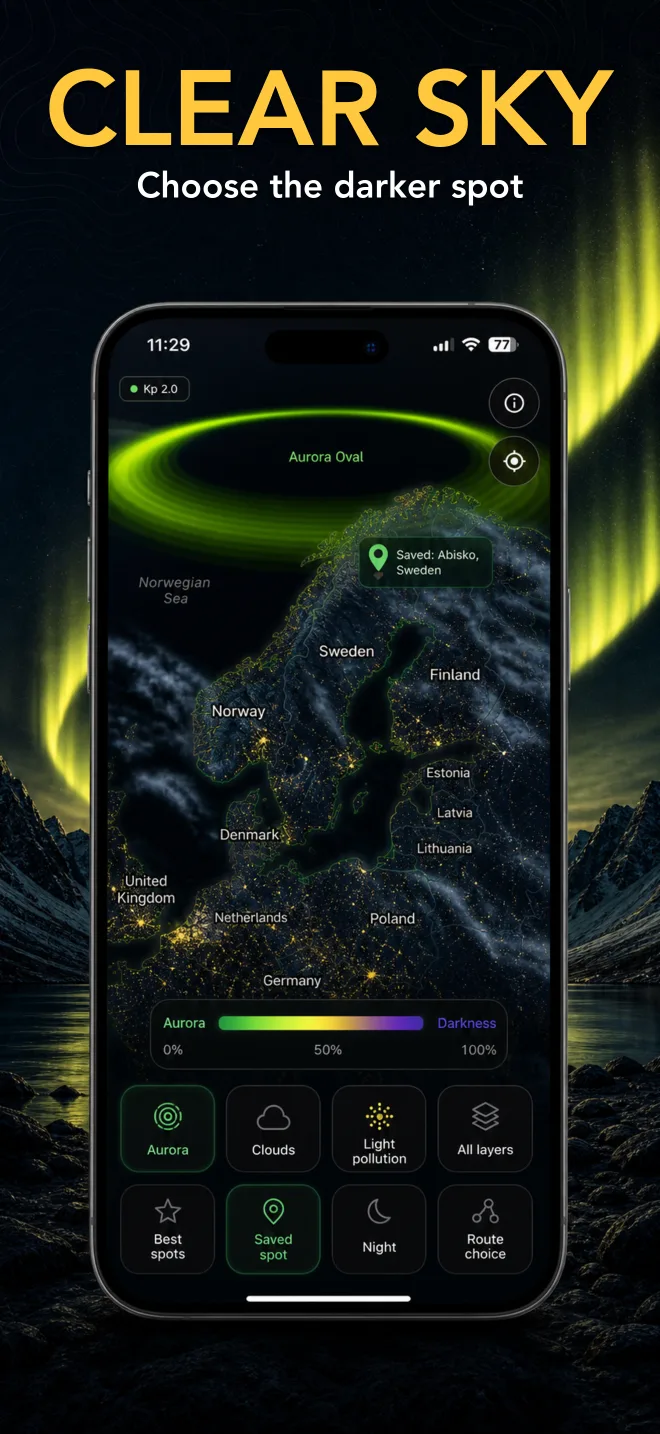
Radar de auroras: este mapa muestra el óvalo auroral actual de NOAA. Comprueba también nubes y oscuridad; es un mapa de pronóstico, no vídeo en directo.
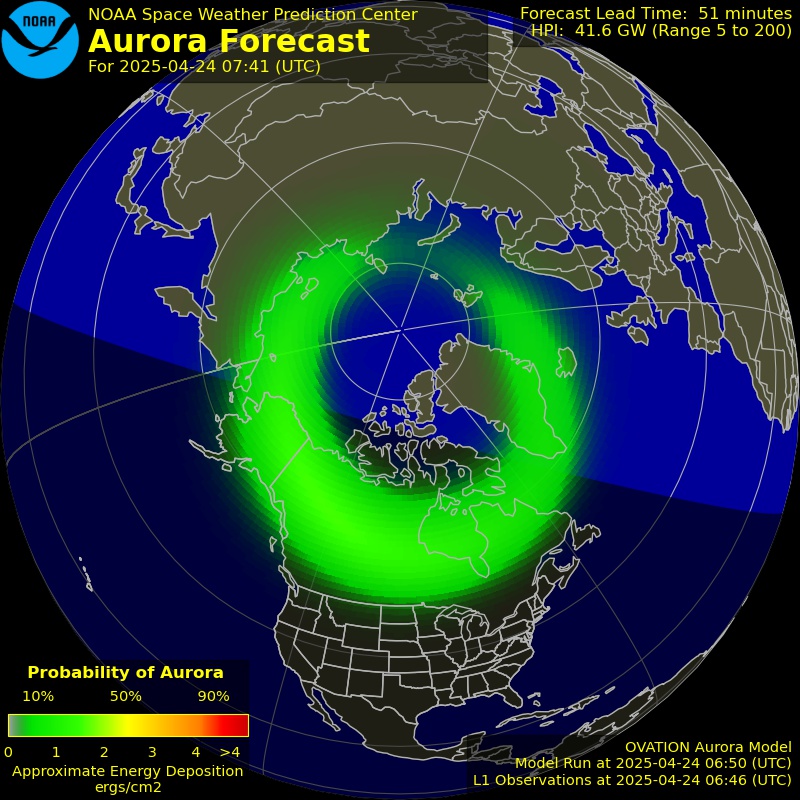
Fuente: NOAA Space Weather Prediction Center. Actualizado cada 30 minutos.
🌟 Dónde la Aurora es Visible Ahora
La aurora es actualmente visible en 45 ubicaciones. Datos en tiempo real actualizados cada 20 minutos.
Honningsvåg
Noruega
Estado Actual
Likely Visible
Ver Pronóstico →
Hammerfest
Noruega
Estado Actual
Likely Visible
Ver Pronóstico →
Vardø
Noruega
Estado Actual
Likely Visible
Ver Pronóstico →
Vadsø
Noruega
Estado Actual
Likely Visible
Ver Pronóstico →
Tromsø
Noruega
Estado Actual
Likely Visible
Ver Pronóstico →
Utsjoki
Finlandia
Estado Actual
Likely Visible
Ver Pronóstico →
Kirkenes
Noruega
Estado Actual
Likely Visible
Ver Pronóstico →
Kilpisjärvi
Finlandia
Estado Actual
Likely Visible
Ver Pronóstico →
Harstad
Noruega
Estado Actual
Likely Visible
Ver Pronóstico →
Kautokeino
Noruega
Estado Actual
Likely Visible
Ver Pronóstico →
Polyarnyy
Rusia
Estado Actual
Likely Visible
Ver Pronóstico →
Severomorsk
Rusia
Estado Actual
Likely Visible
Ver Pronóstico →
Murmansk
Rusia
Estado Actual
Likely Visible
Ver Pronóstico →
Narvik
Noruega
Estado Actual
Likely Visible
Ver Pronóstico →
Lofoten
Noruega
Estado Actual
Likely Visible
Ver Pronóstico →
Leknes
Noruega
Estado Actual
Likely Visible
Ver Pronóstico →
Svolvær
Noruega
Estado Actual
Likely Visible
Ver Pronóstico →
Abisko
Suecia
Estado Actual
Likely Visible
Ver Pronóstico →
Bodø
Noruega
Estado Actual
Likely Visible
Ver Pronóstico →
Sodankylä
Finlandia
Estado Actual
Likely Visible
Ver Pronóstico →
Kirovsk
Rusia
Estado Actual
Likely Visible
Ver Pronóstico →
Naryan-Mar
Rusia
Estado Actual
Likely Visible
Ver Pronóstico →
Gällivare
Suecia
Estado Actual
Likely Visible
Ver Pronóstico →
Vorkuta
Rusia
Estado Actual
Likely Visible
Ver Pronóstico →
Mo i Rana
Noruega
Estado Actual
Likely Visible
Ver Pronóstico →
Ny-Ålesund
Noruega
Estado Actual
Might be Visible
Ver Pronóstico →
Lakselv
Noruega
Estado Actual
Might be Visible
Ver Pronóstico →
Alta
Noruega
Estado Actual
Might be Visible
Ver Pronóstico →
Karasjok
Noruega
Estado Actual
Might be Visible
Ver Pronóstico →
Inari
Finlandia
Estado Actual
Might be Visible
Ver Pronóstico →
Ivalo
Finlandia
Estado Actual
Might be Visible
Ver Pronóstico →
Saariselkä
Finlandia
Estado Actual
Might be Visible
Ver Pronóstico →
Kiruna
Suecia
Estado Actual
Might be Visible
Ver Pronóstico →
Levi
Finlandia
Estado Actual
Might be Visible
Ver Pronóstico →
Apatity
Rusia
Estado Actual
Might be Visible
Ver Pronóstico →
Jokkmokk
Suecia
Estado Actual
Might be Visible
Ver Pronóstico →
Salekhard
Rusia
Estado Actual
Might be Visible
Ver Pronóstico →
Ruka
Finlandia
Estado Actual
Might be Visible
Ver Pronóstico →
Tornio
Finlandia
Estado Actual
Might be Visible
Ver Pronóstico →
Kuusamo
Finlandia
Estado Actual
Might be Visible
Ver Pronóstico →
Kemi
Finlandia
Estado Actual
Might be Visible
Ver Pronóstico →
Arvidsjaur
Suecia
Estado Actual
Might be Visible
Ver Pronóstico →
Luleå
Suecia
Estado Actual
Might be Visible
Ver Pronóstico →
Skellefteå
Suecia
Estado Actual
Might be Visible
Ver Pronóstico →
Levanger
Noruega
Estado Actual
Might be Visible
Ver Pronóstico →
¿Qué es el Índice KP?
El índice KP mide la actividad geomagnética en una escala de 0 a 9. Un KP más alto significa auroras más fuertes que se pueden ver más al sur de los polos magnéticos.
KP 0-2: Actividad débil — visible solo en latitudes muy altas (Fairbanks, Tromsø)
KP 3-5: Moderado — visible en latitudes medias (Reikiavik, Yellowknife, Anchorage)
KP 6-7: Fuerte — visible en latitudes más bajas (Seattle, Edimburgo, Sur de Canadá)
KP 8-9: Extremo — visible en regiones del sur (eventos raros, Nueva York, París)
Importante: Consideramos más que solo KP — la cobertura de nubes, la fase lunar y la oscuridad afectan la visibilidad. Incluso con KP alto, no verá auroras si las nubes bloquean el cielo o durante la luna llena.
Get Alerted Before Aurora Appears
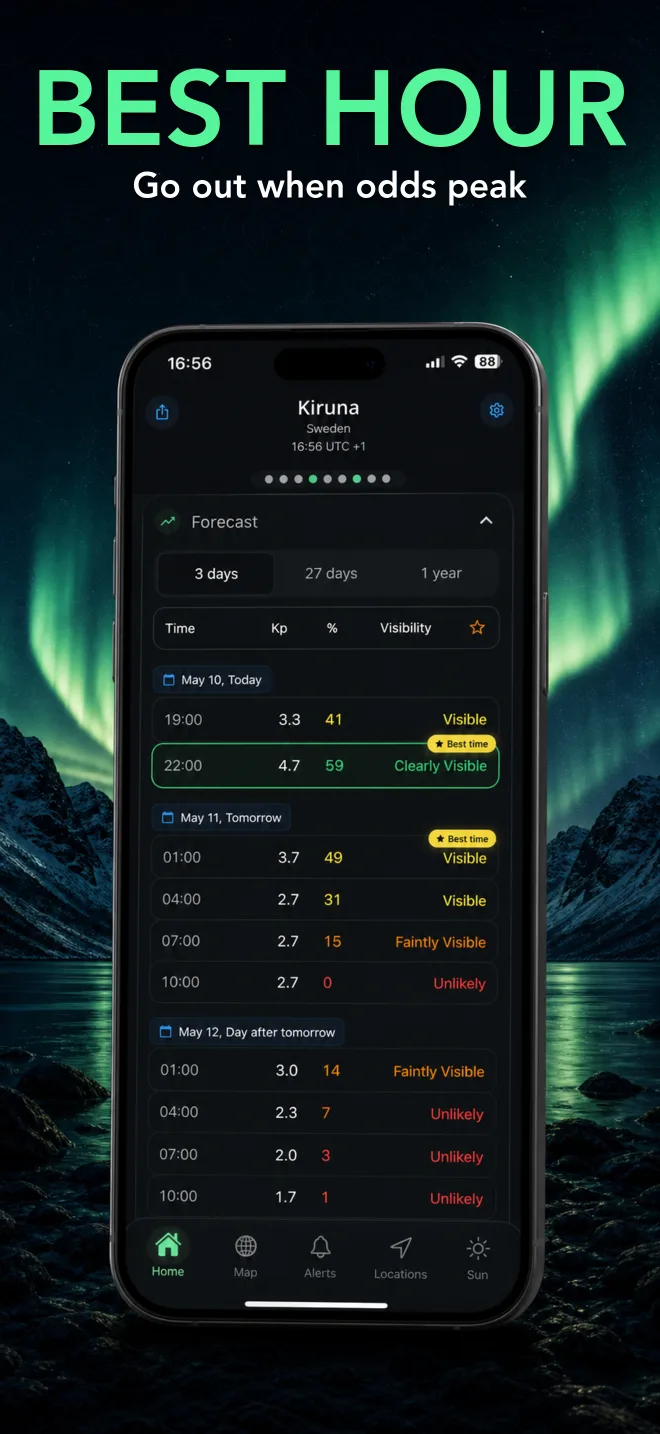
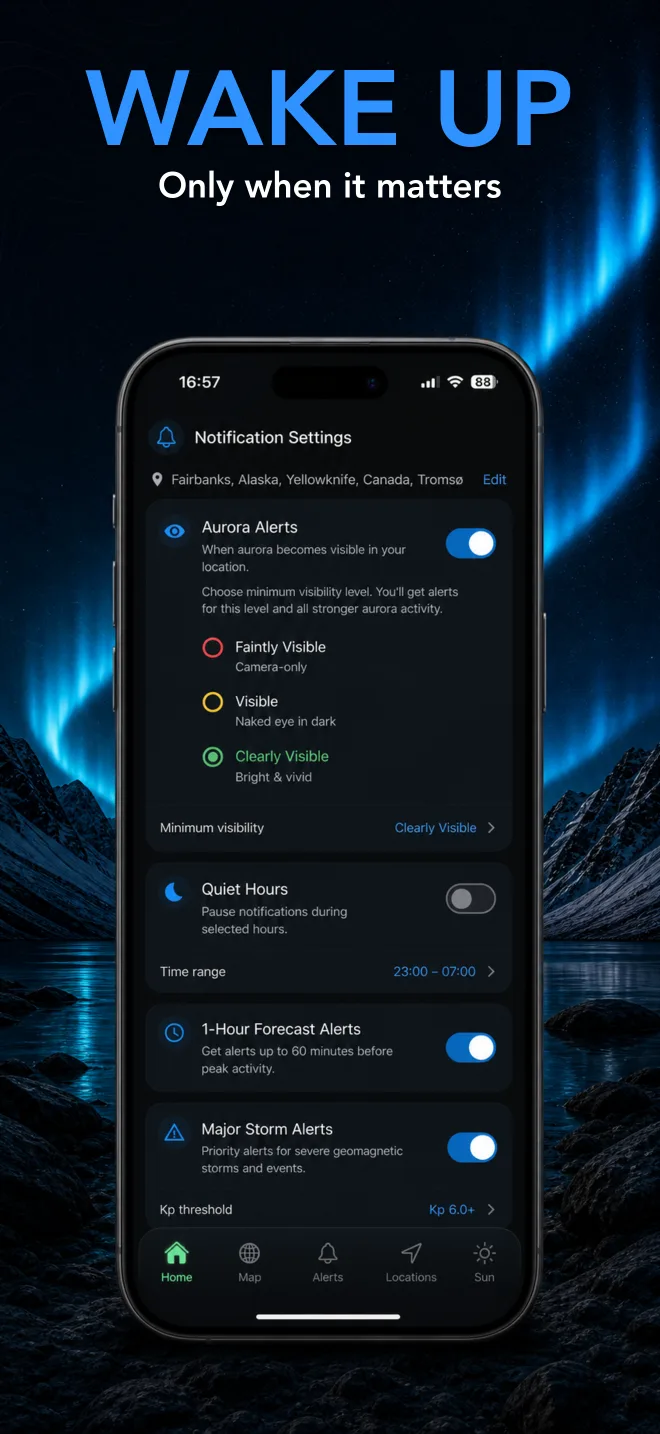
Push alerts 20–90 min before northern lights. 72h forecast, cloud cover, 11 years of historical data.
- KP y clima en tiempo real
- Alertas push
- Mapa de auroras en vivo
- Pronóstico de nubosidad
Frequently Asked Questions
What is the Kp index?
The Kp index measures geomagnetic activity on a scale from 0 to 9, published by NOAA SWPC every 3 hours. Higher Kp means a larger auroral oval and aurora visible at lower latitudes. Kp 3+ is visible in northern Scandinavia, Kp 5+ reaches Scotland and northern US states, Kp 7+ can reach central Europe.
Can I see aurora tonight?
Aurora visibility depends on 5 factors: Kp index (geomagnetic activity), cloud cover, moon phase, hours of darkness, and your magnetic latitude. All five must align — even strong Kp activity is invisible behind clouds or during twilight. Check the forecast for your city to see if conditions align tonight.
What causes the northern lights?
Aurora borealis occurs when charged particles from the solar wind enter Earth's magnetosphere and collide with atmospheric gases. Oxygen produces green light (90–150 km altitude) and red light (above 200 km), while nitrogen creates purple and blue hues. Coronal mass ejections (CMEs) from the Sun trigger the strongest displays.
How does aurora forecasting work?
AuroraMe uses a 5-factor prediction model: real-time Kp index from NOAA SWPC, local cloud cover forecasts, moon phase and illumination, hours of darkness at your location, and magnetic latitude (which determines your minimum Kp threshold). These factors are combined into a single visibility status updated every 15 minutes.
When is the best time to see the northern lights?
The best season is September through March in the northern hemisphere, with peak activity around the equinoxes (September-October, February-March) due to the Russell-McPherron effect. The best hours are 10 PM to 2 AM local time, when geomagnetic substorms peak. Solar Cycle 25 is near its maximum in 2025-2026, making this period exceptionally active.
What Kp level do I need for my location?
Your required Kp depends on magnetic latitude. The formula is roughly: Required Kp = (66 - Magnetic Latitude) / 2. For example, Tromsø (67.4° MLAT) needs just Kp 1, Edinburgh (58.2° MLAT) needs Kp 4, and London (53.4° MLAT) needs Kp 6. Check any city page for the exact Kp threshold calculated from its magnetic latitude.

App Store

Google Play
Scan to download AuroraMe — Free Aurora Alerts
Download on the App Store
GET IT ON Google Play
App Store
Google Play