Monitor zorzy polarnej
Śledź widoczność zorzy polarnej w 1023 lokalizacjach na świecie. Aktualny KP 2.0 — słaba aktywność. Zachmurzenie, faza Księżyca i ciemność.
Radar zorzy: ta mapa pokazuje aktualny owal zorzy NOAA. Sprawdź też chmury i ciemność; to mapa prognozy, nie transmisja wideo.
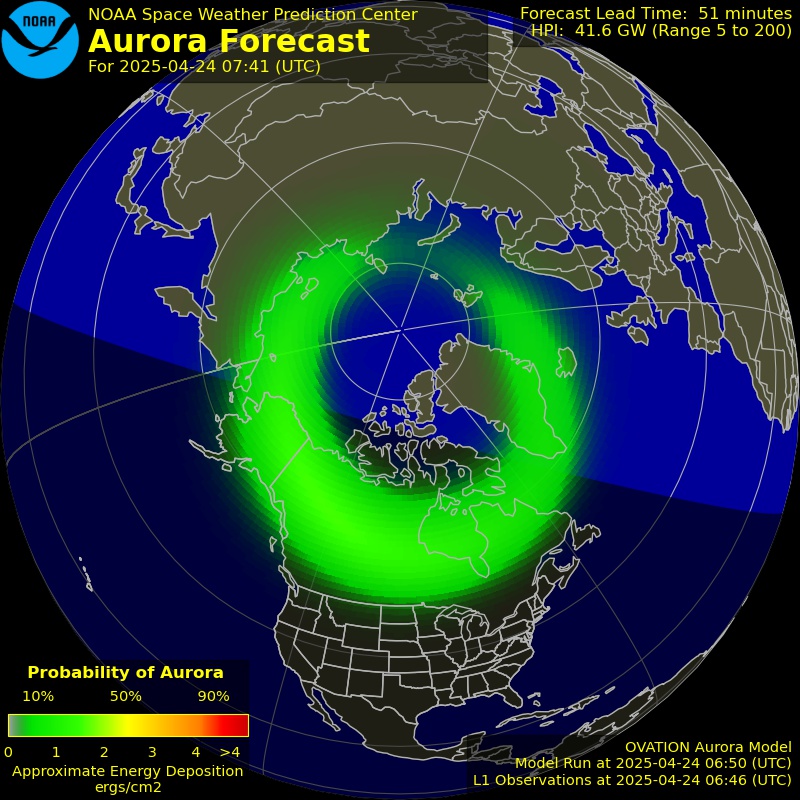
Źródło: NOAA Space Weather Prediction Center. Aktualizowane co 30 minut.
🌟 Gdzie zorza jest widoczna właśnie teraz
Zorza jest aktualnie widoczna w 12 lokalizacjach. Dane w czasie rzeczywistym aktualizowane co 20 minut.
Rankin Inlet
Kanada
Aktualny status
Likely Visible
Zobacz prognozę →
Iqaluit
Kanada
Aktualny status
Likely Visible
Zobacz prognozę →
Yellowknife
Kanada
Aktualny status
Likely Visible
Zobacz prognozę →
Churchill
Kanada
Aktualny status
Likely Visible
Zobacz prognozę →
Thompson
Kanada
Aktualny status
Likely Visible
Zobacz prognozę →
Fort McMurray
Kanada
Aktualny status
Likely Visible
Zobacz prognozę →
Whitehorse
Kanada
Aktualny status
Likely Visible
Zobacz prognozę →
Savissivik
Grenlandia
Aktualny status
Might be Visible
Zobacz prognozę →
Ilulissat
Grenlandia
Aktualny status
Might be Visible
Zobacz prognozę →
Kaktovik
Stany Zjednoczone
Aktualny status
Might be Visible
Zobacz prognozę →
Hay River
Kanada
Aktualny status
Might be Visible
Zobacz prognozę →
Saint Michael
Stany Zjednoczone
Aktualny status
Might be Visible
Zobacz prognozę →
Czym jest indeks KP?
Indeks KP mierzy aktywność geomagnetyczną w skali od 0 do 9. Wyższy KP oznacza silniejszą zorzę, widoczną dalej na południe od biegunów magnetycznych.
KP 0-2: Słaba aktywność — widoczna tylko na bardzo wysokich szerokościach (Fairbanks, Tromsø)
KP 3-5: Umiarkowana — widoczna na średnich szerokościach (Reykjavik, Yellowknife, Anchorage)
KP 6-7: Silna — widoczna na niższych szerokościach (Seattle, Edynburg, Południowa Kanada)
KP 8-9: Ekstremalna — widoczna w południowych regionach (rzadkie zdarzenia, Nowy Jork, Paryż)
Ważne: Uwzględniamy więcej niż tylko KP — zachmurzenie, fazę Księżyca i ciemność. Nawet przy wysokim KP nie zobaczysz zorzy, jeśli chmury blokują niebo lub jest pełnia Księżyca.
Get Alerted Before Aurora Appears
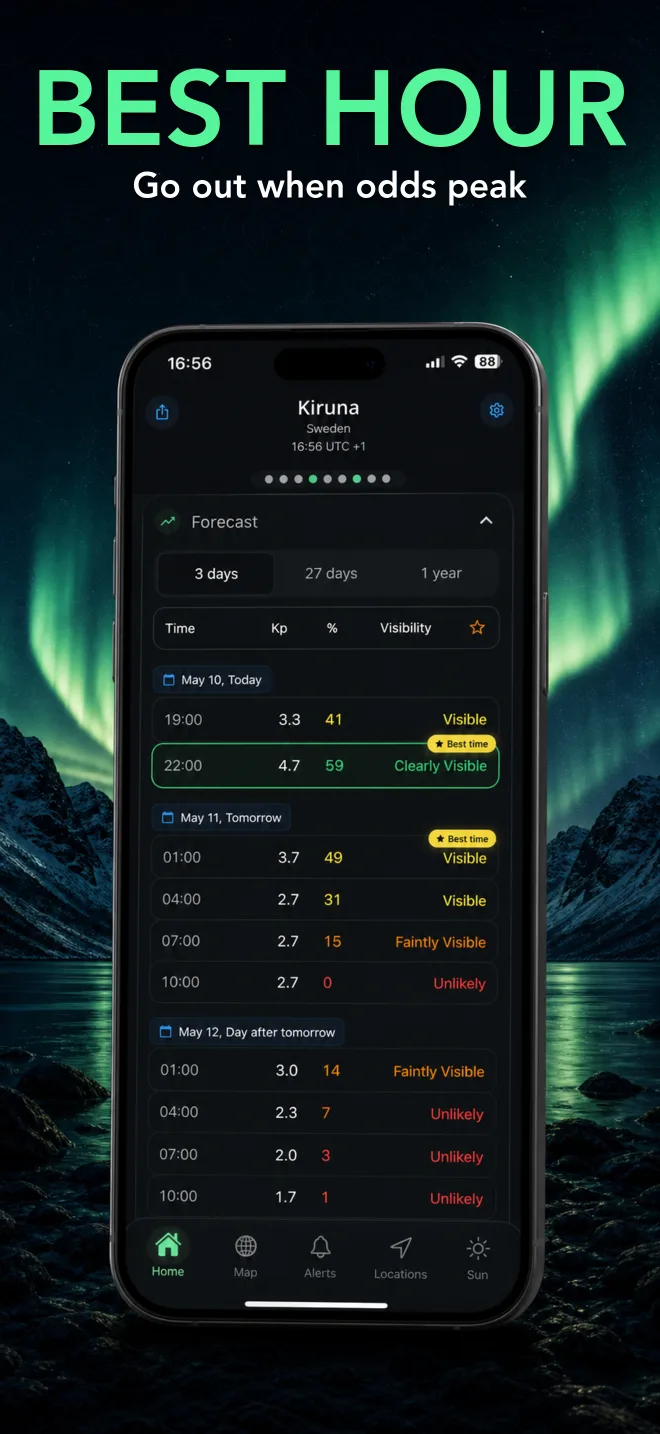
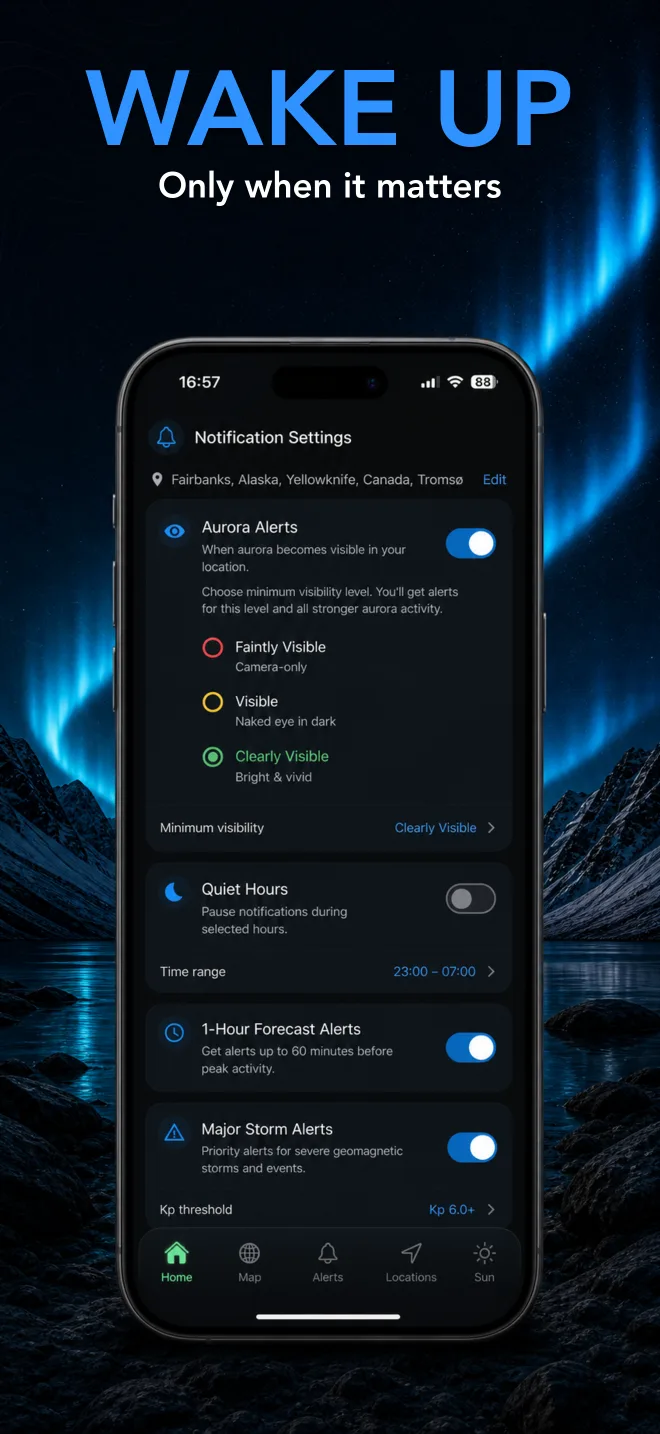
Push alerts 20–90 min before northern lights. 72h forecast, cloud cover, 11 years of historical data.
- KP i pogoda w czasie rzeczywistym
- Alerty push
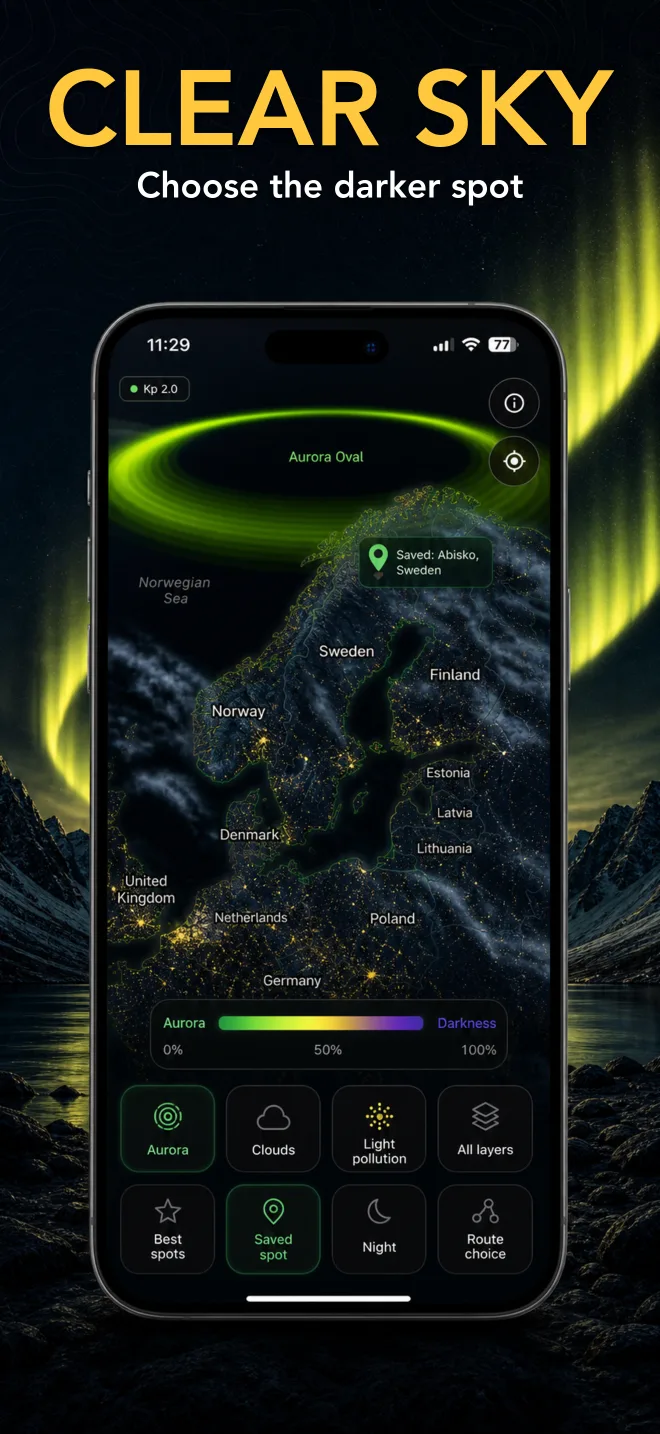
- Mapa zorzy na żywo
- Prognoza zachmurzenia
Frequently Asked Questions
What is the Kp index?
The Kp index measures geomagnetic activity on a scale from 0 to 9, published by NOAA SWPC every 3 hours. Higher Kp means a larger auroral oval and aurora visible at lower latitudes. Kp 3+ is visible in northern Scandinavia, Kp 5+ reaches Scotland and northern US states, Kp 7+ can reach central Europe.
Can I see aurora tonight?
Aurora visibility depends on 5 factors: Kp index (geomagnetic activity), cloud cover, moon phase, hours of darkness, and your magnetic latitude. All five must align — even strong Kp activity is invisible behind clouds or during twilight. Check the forecast for your city to see if conditions align tonight.
What causes the northern lights?
Aurora borealis occurs when charged particles from the solar wind enter Earth's magnetosphere and collide with atmospheric gases. Oxygen produces green light (90–150 km altitude) and red light (above 200 km), while nitrogen creates purple and blue hues. Coronal mass ejections (CMEs) from the Sun trigger the strongest displays.
How does aurora forecasting work?
AuroraMe uses a 5-factor prediction model: real-time Kp index from NOAA SWPC, local cloud cover forecasts, moon phase and illumination, hours of darkness at your location, and magnetic latitude (which determines your minimum Kp threshold). These factors are combined into a single visibility status updated every 15 minutes.
When is the best time to see the northern lights?
The best season is September through March in the northern hemisphere, with peak activity around the equinoxes (September-October, February-March) due to the Russell-McPherron effect. The best hours are 10 PM to 2 AM local time, when geomagnetic substorms peak. Solar Cycle 25 is near its maximum in 2025-2026, making this period exceptionally active.
What Kp level do I need for my location?
Your required Kp depends on magnetic latitude. The formula is roughly: Required Kp = (66 - Magnetic Latitude) / 2. For example, Tromsø (67.4° MLAT) needs just Kp 1, Edinburgh (58.2° MLAT) needs Kp 4, and London (53.4° MLAT) needs Kp 6. Check any city page for the exact Kp threshold calculated from its magnetic latitude.

App Store

Google Play
Scan to download AuroraMe — Free Aurora Alerts
Download on the App Store
GET IT ON Google Play
App Store
Google Play