Revontuliseuranta
Seuraa revontulia 1023 sijainnissa. Nykyinen KP 2.0 — heikko aktiivisuus. Pilvisyys, kuun vaihe ja pimeys tarkkoja ennusteita varten.
Revontulitutka: kartta näyttää NOAAn nykyisen revontuliovaalin. Tarkista myös pilvet ja pimeys; tämä on ennustekartta, ei videolähetys.
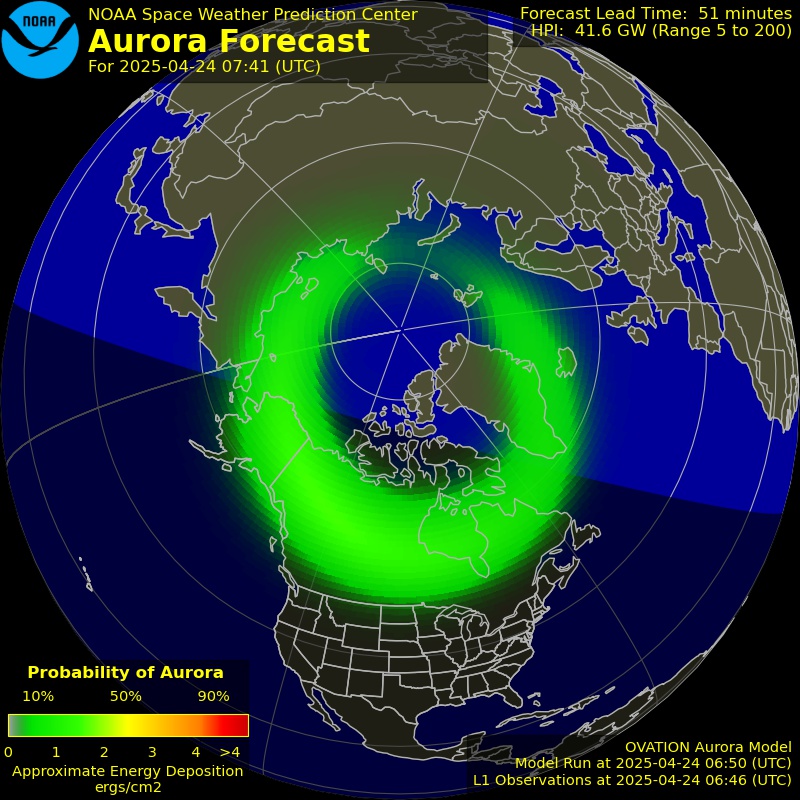
Lähde: NOAA Space Weather Prediction Center. Päivitetty 30 minuutin välein.
🌟 Missä revontulet näkyvät juuri nyt
Revontulet ovat tällä hetkellä näkyvissä 12 sijainnissa. Reaaliaikainen data päivitetty 20 minuutin välein.
Rankin Inlet
Kanada
Nykyinen tila
Likely Visible
Näytä ennuste →
Iqaluit
Kanada
Nykyinen tila
Likely Visible
Näytä ennuste →
Yellowknife
Kanada
Nykyinen tila
Likely Visible
Näytä ennuste →
Churchill
Kanada
Nykyinen tila
Likely Visible
Näytä ennuste →
Thompson
Kanada
Nykyinen tila
Likely Visible
Näytä ennuste →
Fort McMurray
Kanada
Nykyinen tila
Likely Visible
Näytä ennuste →
Whitehorse
Kanada
Nykyinen tila
Likely Visible
Näytä ennuste →
Savissivik
Grönlanti
Nykyinen tila
Might be Visible
Näytä ennuste →
Ilulissat
Grönlanti
Nykyinen tila
Might be Visible
Näytä ennuste →
Kaktovik
Yhdysvallat
Nykyinen tila
Might be Visible
Näytä ennuste →
Hay River
Kanada
Nykyinen tila
Might be Visible
Näytä ennuste →
Saint Michael
Yhdysvallat
Nykyinen tila
Might be Visible
Näytä ennuste →
Mikä on KP-indeksi?
KP-indeksi mittaa geomagneettista aktiivisuutta asteikolla 0–9. Korkeampi KP tarkoittaa voimakkaampia revontulia, jotka voivat näkyä kauempana etelässä magneettisista navoista.
KP 0-2: Heikko aktiivisuus — näkyy vain erittäin korkeilla leveysasteilla (Fairbanks, Tromsø)
KP 3-5: Kohtalainen — näkyy keskileveysasteilla (Reykjavik, Yellowknife, Anchorage)
KP 6-7: Voimakas — näkyy eteläisemmillä leveysasteilla (Seattle, Edinburgh, Etelä-Kanada)
KP 8-9: Äärimmäinen — näkyy eteläisillä alueilla (harvinaisia tapahtumia, New York, Pariisi)
Tärkeää: Otamme huomioon muutakin kuin pelkän KP:n — pilvisyys, kuun vaihe ja pimeys vaikuttavat kaikki näkyvyyteen. Vaikka KP olisi korkea, et näe revontulia, jos pilvet peittävät taivaan tai on täysikuu.
Get Alerted Before Aurora Appears
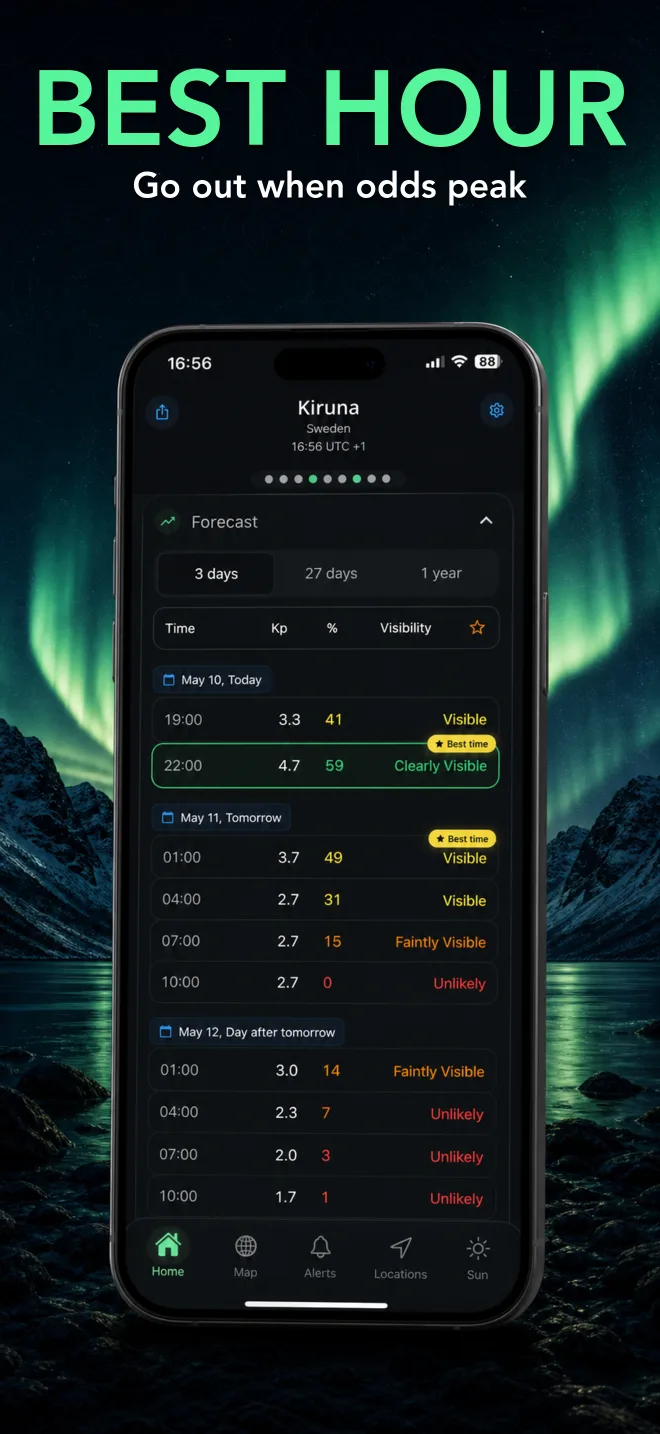
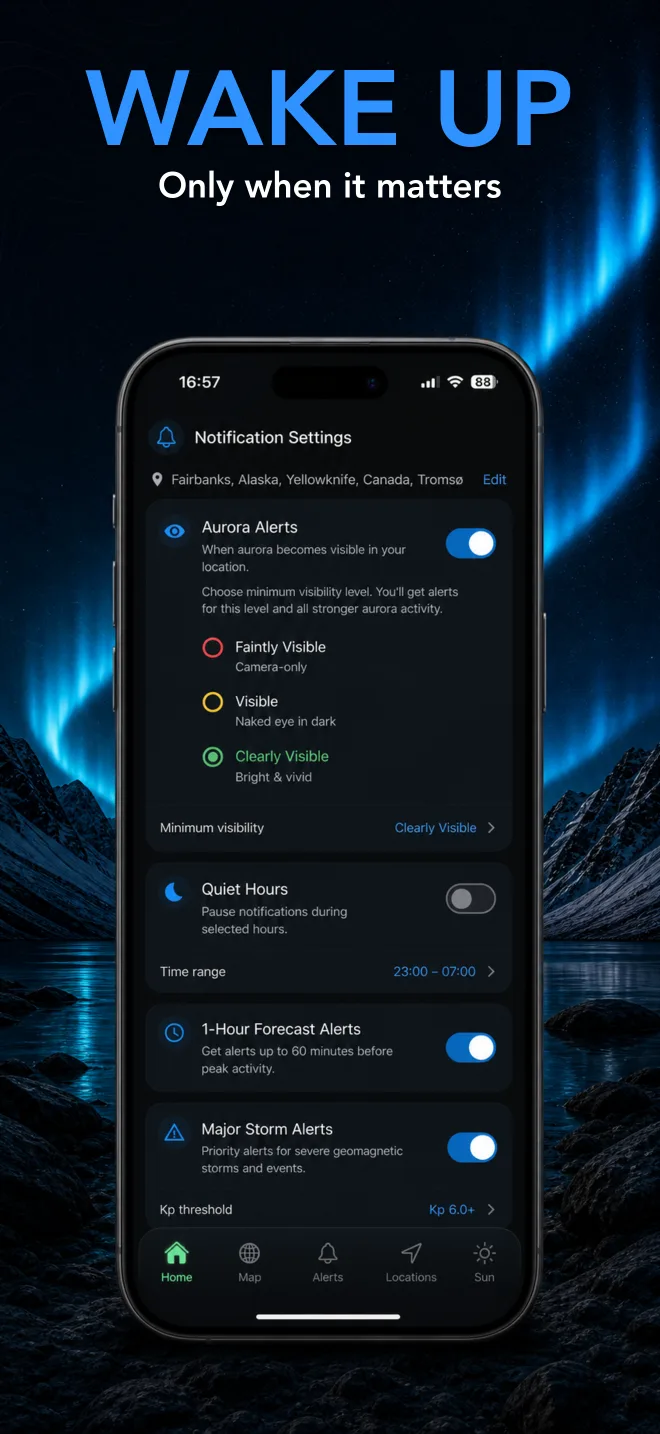
Push alerts 20–90 min before northern lights. 72h forecast, cloud cover, 11 years of historical data.
- Reaaliaikainen KP ja sää
- Push-hälytykset
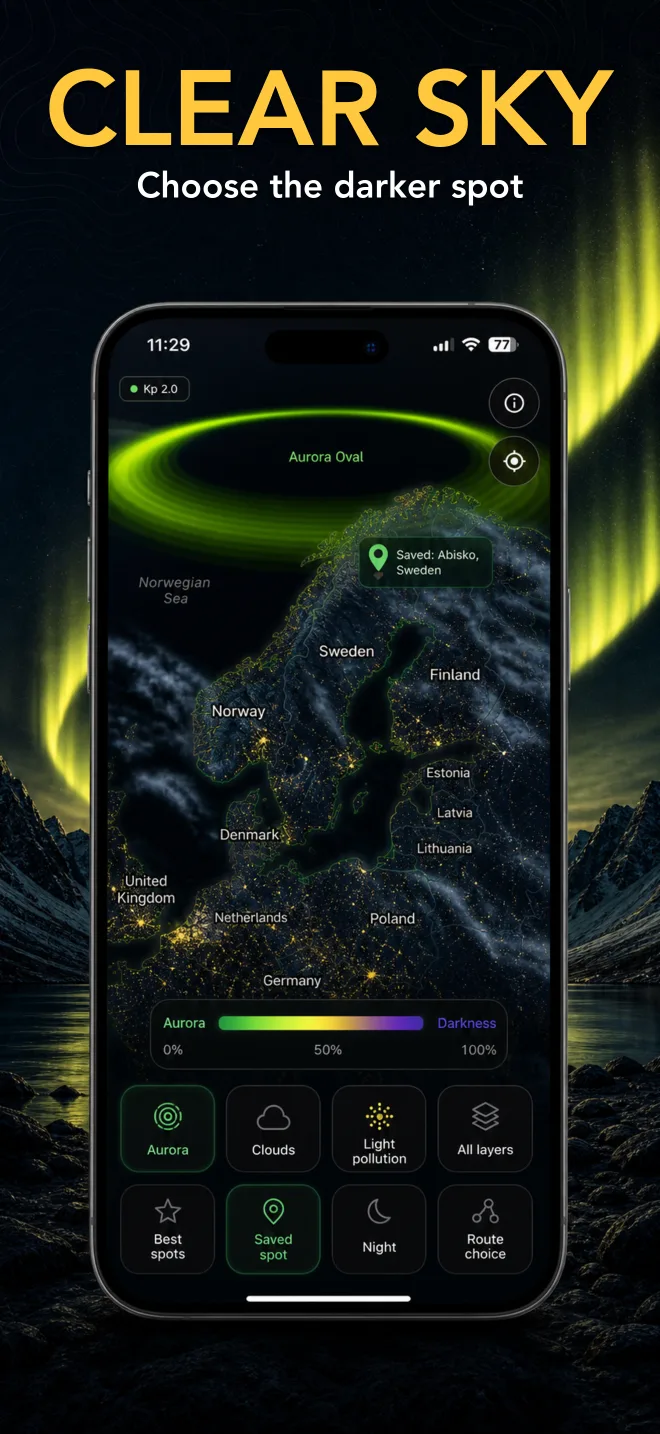
- Reaaliaikainen revontulikartta
- Pilvisyysennuste
Frequently Asked Questions
What is the Kp index?
The Kp index measures geomagnetic activity on a scale from 0 to 9, published by NOAA SWPC every 3 hours. Higher Kp means a larger auroral oval and aurora visible at lower latitudes. Kp 3+ is visible in northern Scandinavia, Kp 5+ reaches Scotland and northern US states, Kp 7+ can reach central Europe.
Can I see aurora tonight?
Aurora visibility depends on 5 factors: Kp index (geomagnetic activity), cloud cover, moon phase, hours of darkness, and your magnetic latitude. All five must align — even strong Kp activity is invisible behind clouds or during twilight. Check the forecast for your city to see if conditions align tonight.
What causes the northern lights?
Aurora borealis occurs when charged particles from the solar wind enter Earth's magnetosphere and collide with atmospheric gases. Oxygen produces green light (90–150 km altitude) and red light (above 200 km), while nitrogen creates purple and blue hues. Coronal mass ejections (CMEs) from the Sun trigger the strongest displays.
How does aurora forecasting work?
AuroraMe uses a 5-factor prediction model: real-time Kp index from NOAA SWPC, local cloud cover forecasts, moon phase and illumination, hours of darkness at your location, and magnetic latitude (which determines your minimum Kp threshold). These factors are combined into a single visibility status updated every 15 minutes.
When is the best time to see the northern lights?
The best season is September through March in the northern hemisphere, with peak activity around the equinoxes (September-October, February-March) due to the Russell-McPherron effect. The best hours are 10 PM to 2 AM local time, when geomagnetic substorms peak. Solar Cycle 25 is near its maximum in 2025-2026, making this period exceptionally active.
What Kp level do I need for my location?
Your required Kp depends on magnetic latitude. The formula is roughly: Required Kp = (66 - Magnetic Latitude) / 2. For example, Tromsø (67.4° MLAT) needs just Kp 1, Edinburgh (58.2° MLAT) needs Kp 4, and London (53.4° MLAT) needs Kp 6. Check any city page for the exact Kp threshold calculated from its magnetic latitude.

App Store

Google Play
Scan to download AuroraMe — Free Aurora Alerts
Download on the App Store
GET IT ON Google Play
App Store
Google Play