

Tonight in Idaho Falls: Aurora is unlikely in Idaho Falls right now. Current Kp is 3.3, below the local Kp 8+ threshold. AuroraMe watches Kp, clouds and darkness for this location and sends a free alert when the next viewing window opens.
aurora visibility now
Unlikely
Kp 3.3 (Good) — need Kp 8+ here
Kp now 3.3 Too low need 8+
Clouds 100% Overcast
Sky Dark visibility
Weather data by Open-Meteo.com Licensed under CC BY 4.0. Modified by AuroraMe: location snapped to a privacy-preserving 0.25° grid and values rounded for display.
Get a 72-hour aurora forecast and free alerts for Idaho Falls AuroraMe tracks Kp, clouds and darkness for Idaho Falls, then sends a free push when the next viewing window opens.
Forecast
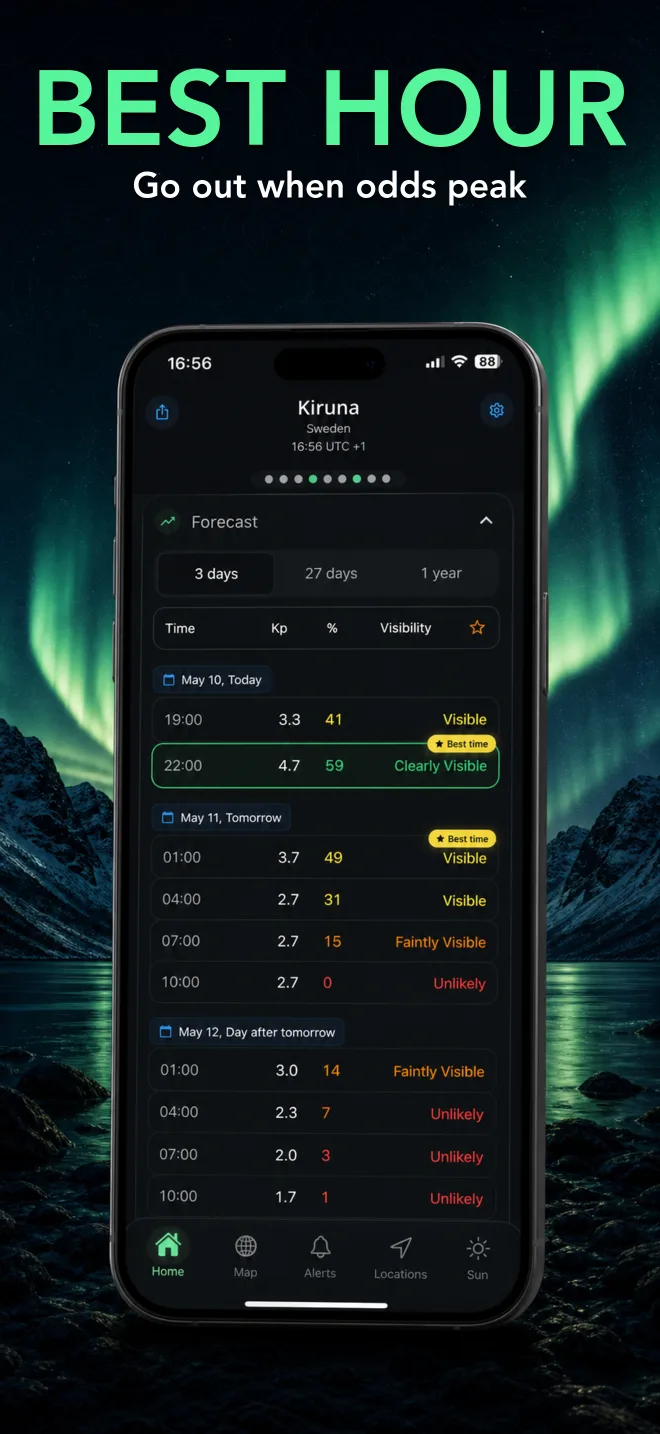
Scan the next hours here. The app watches the next 72 hours and alerts you when conditions line up.
Time
Kp
Visibility
12.10, Today
06:00
2.3
Unlikely
07:00
2.3
Unlikely
08:00
2.3
Unlikely
09:00
2.7
Unlikely
10:00
2.7
Unlikely
11:00
2.7
Unlikely
Kp Index: 27-Day Forecast
Predicted geomagnetic activity based on solar rotation cycle.
—
aurora nights per year
Forecast temporarily unavailable. Check back in a few minutes.
Jan
Feb
Mar
Apr
May
Jun
Jul
Aug
Sep
Oct
Nov
Dec
Best Months to Visit Sep, Oct, Mar, Apr
Planning a trip? Find the best month and how many nights to stay
📅 All 12 months ranked 🛏️ Min nights for 80% chance 🔔 Push alert 1h before aurora 🌙 72-hour forecast
Why this forecast?
Five signals decide whether you'll see aurora from Idaho Falls tonight. AuroraMe re-checks them every 15 minutes, and all five have to line up: even a strong storm stays invisible behind clouds or in a bright sky.
Aurora Zone
Higher magnetic latitude = better aurora visibility. Your location's magnetic latitude determines how often auroras appear overhead.
Status Levels:
Perfect Above 62.0° — Excellent aurora visibility (daily activity)
Good 56.0° - 62.0° — Good aurora visibility (regular storms)
Acceptable 50.0° - 56.0° — Fair aurora visibility (strong storms only)
Low Below 50.0° — Poor aurora visibility (extreme storms)
Aurora Zone
Acceptable 50.7°
Kp index
Kp measures global magnetic disturbance. Higher Kp = stronger auroras visible at lower latitudes.
Status Levels:
Storm Kp 6-9 — Geomagnetic storm, strong auroras
Active Kp 3-6 — Moderate activity, good conditions
Quiet Kp 1-3 — Low activity, weak auroras
Very Quiet Kp 0-1 — Very quiet, minimal auroras
Kp index
Active 3.3
Cloud Cover Impact
Clear skies are essential for aurora viewing. Clouds block your view of the northern lights. The percentage shows cloud coverage (0% = clear skies, 100% = overcast).
Status Levels:
Clear Clear (0-25%) — Perfect for aurora viewing
Partly Cloudy Partly Cloudy (26-50%) — May partially block view
Cloudy Cloudy (51-85%) — Significantly blocks aurora
Overcast Overcast (85%+) — Blocks aurora completely
Cloud Cover Impact
☁️ Overcast 100%
Moonlight
Bright moonlight can wash out faint auroras. New moon provides the darkest skies for optimal viewing.
Status Levels:
New Moon Darkest skies — Best for faint auroras
Crescent Dim moonlight — Good for viewing
Quarter Moderate moonlight — May wash out weak auroras
Gibbous Bright moonlight — Reduces aurora visibility
Full Moon Very bright — Only strong auroras visible
Moonlight
🌑 New Moon 4%
Darkness
Darker skies are essential for aurora viewing. The sun must be below the horizon for auroras to be visible.
Status Levels:
Night Darkest conditions — Optimal for auroras
Astronomical Twilight Dark enough — Good aurora viewing
Nautical Twilight Getting darker — Weak auroras may appear
Daylight Sun is above horizon — No aurora visible
Darkness
Astronomical Twilight
Aurora Borealis Viewing in Idaho Falls
Eastern Idaho city with clear high-desert skies for northern lights.
Idaho Falls sits at 50.7° magnetic latitude, which means aurora typically becomes visible when the Kp index reaches 8+. Aurora sightings in Idaho Falls require stronger geomagnetic storms (Kp 8+), which occur a few times per year. When storms do hit, the best viewing window is 10 PM to 2 AM local time under clear, dark skies.
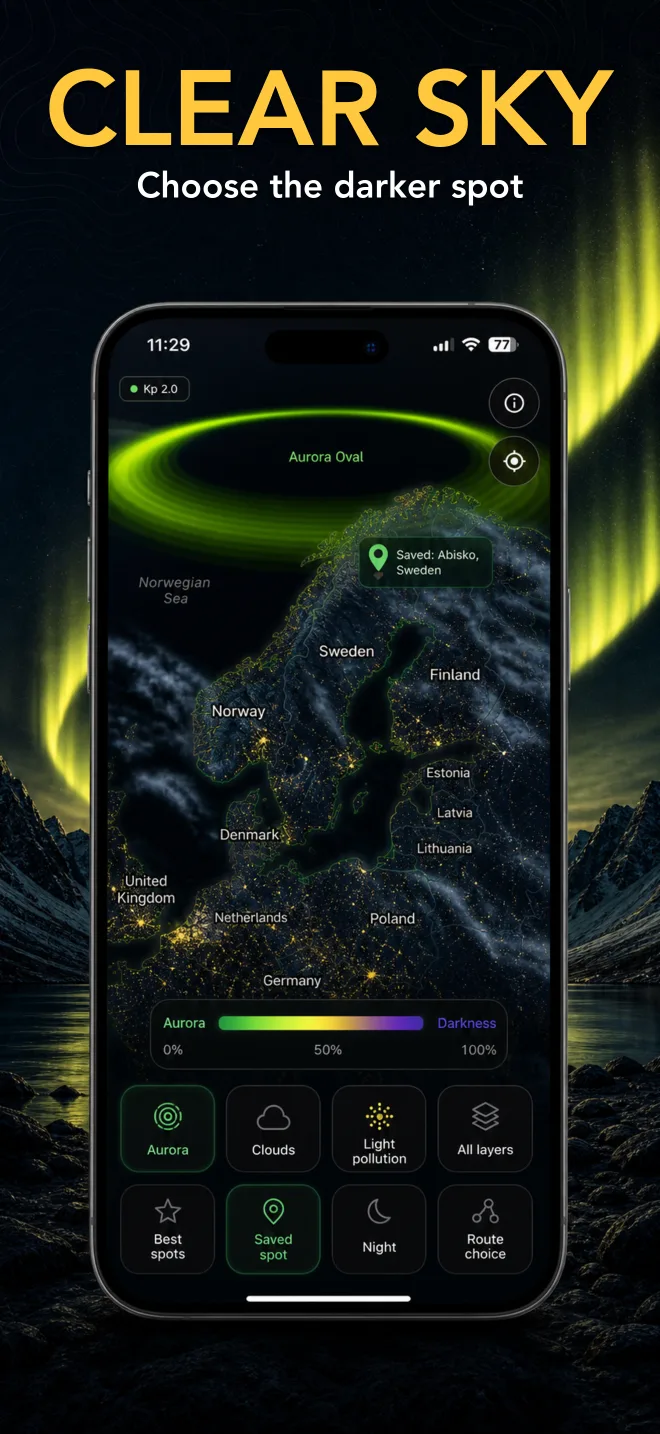
Cloud cover is the most common reason people miss aurora even during strong storms. AuroraMe combines the Kp index with real-time cloud forecasts, moon phase, and darkness data to give you a single visibility status — so you know whether it's worth going outside tonight.
For the broader storm picture before checking Idaho Falls, start with the broader forecast hub and the geomagnetic storm tracker. Low-latitude places like Idaho Falls usually need a severe geomagnetic storm, clear northern horizon, and full darkness before northern lights become realistic.
Get Alerted Before Aurora Appears
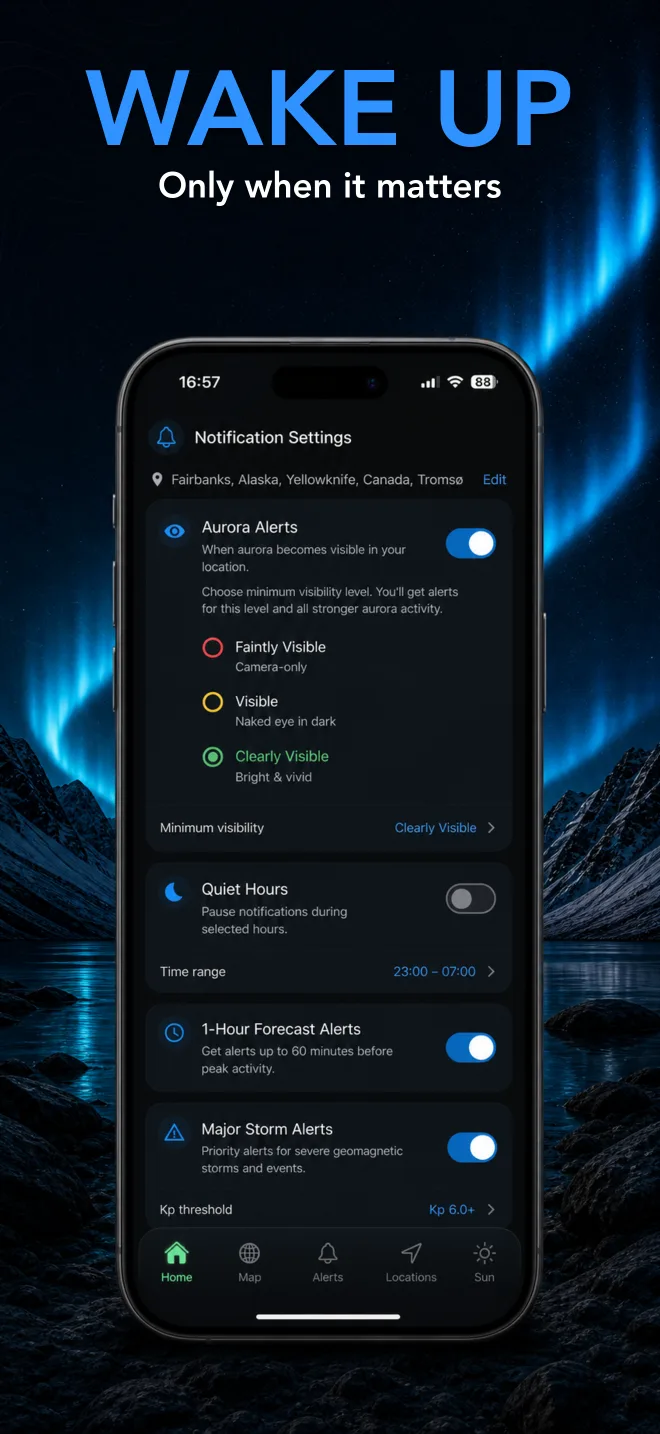
Push alerts 20–90 min before northern lights. 72h forecast, cloud cover, 11 years of historical data.
Smart Alerts before spikes
Short-term outlook for the next few days
Multiple locations
27 days & Year: plan your trip
Aurora is Rare in Idaho Falls — But Not Impossible
Kp 8+ needed to see aurora here
0 possible aurora nights in the next 27 days
Sep, Oct, Mar, Apr best months to visit
Other cities in United States
Bozeman
Montana State University city with mountain aurora photography opportunities
CURRENT STATUS
Unlikely
View
Salt Lake City
Utah capital surrounded by mountains with elevated aurora viewing potential
CURRENT STATUS
Unlikely
View
Park City
High-altitude ski resort city with pristine aurora viewing conditions
CURRENT STATUS
Unlikely
View
Boise
Idaho capital with high elevation aurora viewing from foothills
CURRENT STATUS
Unlikely
View
Helena
Montana capital in Rocky Mountain foothills with aurora potential
CURRENT STATUS
Unlikely
View
Billings
Montana's largest city with Great Plains aurora viewing opportunities
CURRENT STATUS
Unlikely
View
Planning a trip? See the best months for Idaho Falls → • Northern lights tonight — all cities →
Learn More About the Northern Lights
- How to See the Northern Lights — Beginner's Guide
- Kp Index Explained — What It Means for Aurora
- Best Time to See the Northern Lights
- Geomagnetic Storms Explained — G1–G5 Scale
- Best Aurora Forecast Apps (Free & Paid)
- Northern Lights vs Aurora Borealis — The Same Thing?
- Can You See the Aurora With the Naked Eye?
Northern Lights in Idaho Falls: Quick Guide
Minimum Kp Needed
8.0+
Viewing Frequency
rare
Current Kp Index
3.3
How often can you see northern lights in Idaho Falls?
Based on its magnetic latitude of 50.7°, aurora viewing in Idaho Falls is rare (5-15 nights per year, mainly during strong storms). We are currently near solar maximum (2024-2025), so expect higher-than-average activity.
Best viewing season: September to March, with peak activity during equinoxes (September and March).
What Kp index do I need to see aurora in Idaho Falls?
For Idaho Falls, you need a minimum Kp index of 8.0 for aurora to be visible. This threshold is calculated based on the city's magnetic latitude (50.7°).
Higher Kp values produce brighter, more active displays:
- Kp 8.0-9.0: Faint aurora visible in dark skies
- Kp 9.0+: Strong, colorful displays visible even with some light pollution
Current Kp index: 3.3
Where should I look for aurora in Idaho Falls?
Aurora is rarely visible this far south. When it does appear during extreme storms (Kp 7+), look for a faint glow on the northern horizon.
For best results, seek locations with minimal light pollution and unobstructed views of the sky. From Idaho Falls, aurora typically remains closer to the horizon, so elevated viewing locations help.
Can I see northern lights tonight in Idaho Falls?
Unlikely: Aurora unlikely tonight with Kp 3.3 (below 8.0 threshold for Idaho Falls). Enable alerts to catch future opportunities.
Real-time conditions: 100% cloud cover, Aurora Score 0/100. Check the live forecast above for the latest updates.
Traveling? Track multiple locations easily
Compare aurora chances across cities and get alerts for all your planned destinations.
For brighter shows consider Fairbanks , Yellowknife