Northern Lights in Summer: 2027 Twilight Calendar
See when civil, nautical and astronomical darkness return in eight aurora cities during 2027, with daily calculations and limits.
Summer can still bring geomagnetic activity. What it removes at high northern latitudes is the dark sky that makes a faint or moderate display easy to see. This 2027 calendar separates three questions that are often collapsed into one: how far below the horizon the Sun gets, when twilight remains, and how the southern hemisphere reverses the northern schedule. It does not forecast aurora, clouds or the outcome of a trip.
The practical rule is simple: start with darkness, then check current geomagnetic activity and the aurora oval, then check local clouds and your viewing site. A summer calendar can tell you when the first condition returns. It cannot tell you whether the other three will line up.
What the three darkness thresholds mean
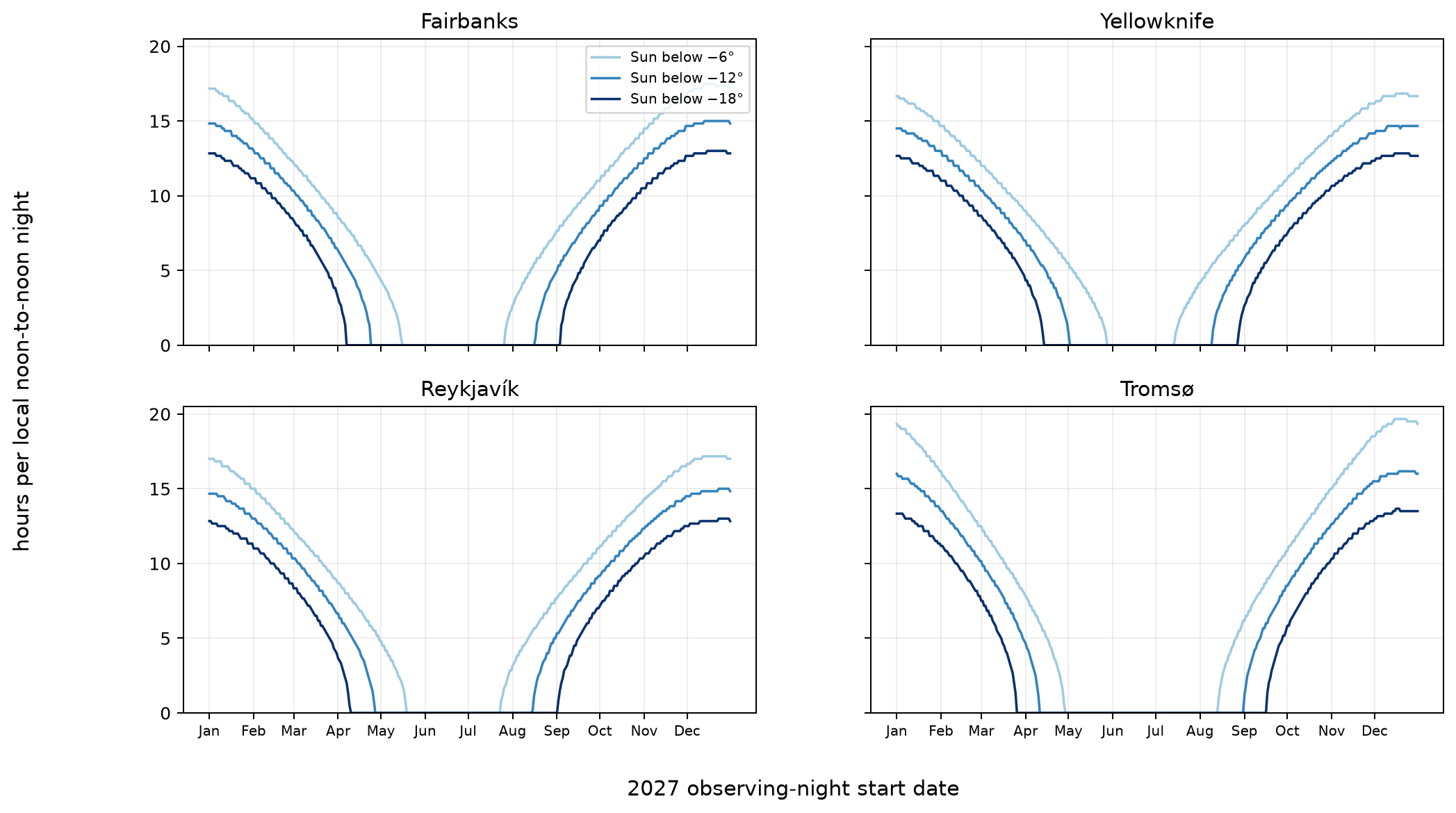
The US Naval Observatory defines civil twilight as the Sun moving from 0° to −6°, nautical twilight from −6° to −12°, and astronomical twilight from −12° to −18°. Below −18° is astronomical darkness. The plotted CSV columns are cumulative hours below −6°, −12° and −18°, rather than the duration of three separate twilight bands.
For this reference, a local observing night runs from local noon to the following local noon. That places the after-midnight hours with the evening that led into them, including when daylight-saving time changes the clock length of the interval. The calculations use the Sun’s apparent topocentric centre every ten minutes, with no atmospheric refraction, terrain or custom horizon.
The strict −18° line is deliberately conservative for aurora planning. A bright display can be noticed in twilight, while a weak display can be lost in astronomical darkness because of clouds, moonlight or city light. So a zero means “no ten-minute sample with the Sun below −18°,” not “no aurora can be visible.” NOAA’s aurora viewing guidance likewise treats darkness as one condition alongside activity, location and timing.
When strict darkness disappears in northern summer
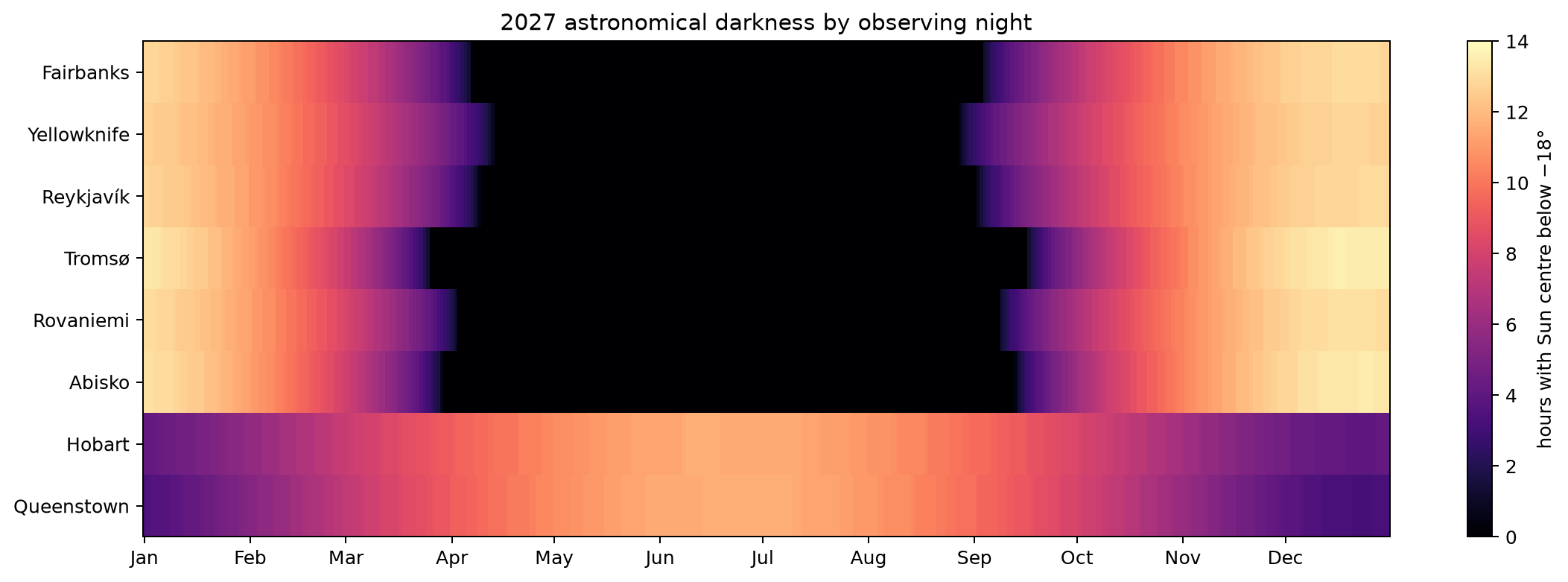
In Fairbanks, the strict −18° interval is absent from April 7 through September 3 in this 2027 calculation: 150 observing nights. Yellowknife has no strict astronomical-darkness sample from April 14 through August 27, a span of 136 nights. Reykjavík’s corresponding run is April 10 to September 1; Tromsø’s is longer, March 26 to September 16. Rovaniemi and Abisko sit between those examples.
Those dates are more useful than a generic statement that “summer is bad.” They show why an August itinerary is a shoulder season, not a clone of July. In Yellowknife the first strict-darkness nights return before September, but a full dark-night season builds progressively. In Tromsø, a date that still offers civil or nautical twilight may remain far from the −18° standard. Use the table below as a schedule prompt, then use the live aurora tracker for the actual evening.
| City | 2027 run with no −18° sample | What the result means |
|---|---|---|
| Fairbanks | Apr 7–Sep 3 | Strict darkness returns in early September. |
| Yellowknife | Apr 14–Aug 27 | Late August is a narrow shoulder; the dark window grows through September. |
| Reykjavík | Apr 10–Sep 1 | Summer twilight is long even after sunset. |
| Tromsø | Mar 26–Sep 16 | The strict criterion gives the longest northern gap in this group. |
| Rovaniemi | Apr 3–Sep 8 | The autumn return follows the same gradual pattern. |
| Abisko | Mar 30–Sep 12 | A clear-sky reputation does not create astronomical darkness in summer. |
This is not a destination ranking. It does not include terrain, cloud frequency or the Kp level required for a city. The eight-city aurora calendar keeps its historical Kp/darkness baseline and cloud normals separate too.
Twilight still carries useful information
The three thresholds show why “it gets dark” is too vague. A night can have many hours below −6° and none below −18°. Civil twilight remains bright; nautical twilight is darker but can retain a visible horizon. Astronomical darkness is a comparison threshold, not a promise of a black sky at every site.
For a real evening, do not decide from a seasonal curve alone. Check the live forecast for your location, the current Kp index explanation, cloud cover and a safe open horizon. A strong storm can make an aurora more conspicuous than a weak one in the same twilight, but no historical darkness chart can assign that likelihood for tonight.
The southern calendar runs the other way
Hobart and Queenstown do not have a zero −18° run in this reference year. Their longest dark windows occur around the June solstice, when northern destinations are in their lightest season. In June 2027, the calculation gives 345.5 total astronomical-dark hours in Hobart and 347.8 in Queenstown across local observing nights, or about 11.5 and 11.6 hours per night. In December those totals contract to 129.8 and 106.0 hours, about 4.2 and 3.4 hours per night.
That reversal is the useful planning message. A southern winter is not an automatic aurora trip: the two cities are farther from the usual auroral oval than Arctic destinations. Read the Aurora Australis forecast guide alongside the same local-night checks rather than importing a northern seasonal rule unchanged.
Check moonlight after choosing a dark window
Moon phase alone does not describe moonlight during a useful observing window: a bright Moon may be below the horizon, while a less-full Moon can be above it throughout. Use the full-Moon northern-lights guide for the date-and-city calculation; its downloadable grid windows carry local dates and UTC offsets and are not advertised as exact moonrise or moonset times.
How to use this for a summer date
First, select a city and date, then read the daily darkness row. If the strict value is zero, do not treat that as a physical absence of aurora. If it has a dark window, check its Moon overlap. Then replace planning inputs with the live forecast, hourly clouds and a safe open view.
For broader travel planning, compare the seasonal darkness here with the city-specific best time guide and the local forecast page. For an actual night, the current forecast and aurora weather guide matter more than a 2027 geometry table.
Methods and limits
This reference uses JPL DE440s through Skyfield for all eight published city coordinates. The Sun and Moon are calculated as apparent topocentric centre positions without atmospheric refraction. Every local-noon-to-next-noon interval is sampled at ten-minute midpoints, so a threshold boundary is resolved only to roughly one grid interval. The Skyfield almanac documentation explains the ephemeris and topocentric methods; the US Naval Observatory publishes primary Moon-phase times in Universal Time.
For the March 22, 2027 full Moon, the calculation gives 10:43:48 UTC and the US Naval Observatory API gives 10:44 UTC. The public method and source manifest lists the ephemeris hash, input hash, definitions and validation checks.
No row models cloud cover, mountain horizons, nearby lighting, human vision, camera exposure, actual auroral activity or a chance of seeing anything. Those omitted inputs are the reason a seasonal darkness chart should guide planning rather than make a viewing promise.