Full Moon Northern Lights: 2027 Moonlight Windows
Compare 2027 moonlight and astronomical darkness for eight aurora cities, with nightly calculations, downloads and practical limits.
A full Moon can reduce the contrast of a faint aurora, but it does not switch geomagnetic activity off. The useful question is not simply “Is it a full Moon?” It is whether the Moon is above your horizon while the sky is dark, how bright its illuminated fraction is, and whether auroral activity and clouds are favourable. Check the live aurora forecast, local darkness and moonlight, and cloud forecast together.
What a full Moon changes
Moonlight brightens the sky background. That can make a faint arc or a low-horizon glow harder to distinguish, especially near city lights. It does not alter the solar wind, Kp, the auroral oval, or the brightness produced in the upper atmosphere. NOAA’s viewing guidance treats darkness, geomagnetic activity, location and timing as separate conditions; a Moon phase is one contrast factor, not an aurora forecast.
That distinction matters in both directions. A bright Moon does not make a strong display impossible to see, and a new Moon does not make a quiet geomagnetic night productive. Start with the Kp index and your location’s threshold, then assess darkness, Moon and clouds. If activity is suitable, a local forecast can tell you whether the moonlight and weather are likely to be the practical constraints.
The Moon’s phase is a useful first clue because it describes how much of the lunar disk is illuminated. It does not say whether the disk is above your horizon during the observing window. A waning gibbous Moon can still be bright but set before much of the dark period. A first-quarter Moon can remain above the horizon during the part of the night you hoped to observe. The same phase also behaves differently across latitude, season and local time.
The three checks that matter
- Auroral conditions. Look at the current aurora forecast and the local Kp context. Kp is a planetary index and a guide, not a promise of a local sighting. How AuroraMe combines space-weather and local-sky inputs explains the separate layers.
- Astronomical darkness. This reference calls the sky astronomically dark when the Sun’s centre is below −18°. That is a strict planning threshold. Bright aurora can still be noticed in twilight, so a zero value under this definition does not mean “no aurora.”
- Moon geometry. During the dark period, compare the Moon’s illuminated fraction with whether it is above the local horizon. A low or hidden Moon can leave more dark time than the phase name alone suggests.
Clouds and light pollution remain separate. A Moon-below-horizon calculation does not create a clear sky or remove city glow. Use the aurora weather guide for the cloud layer, and choose a safe viewing site with a clear horizon in the likely aurora direction.
A 2027 reference across eight cities
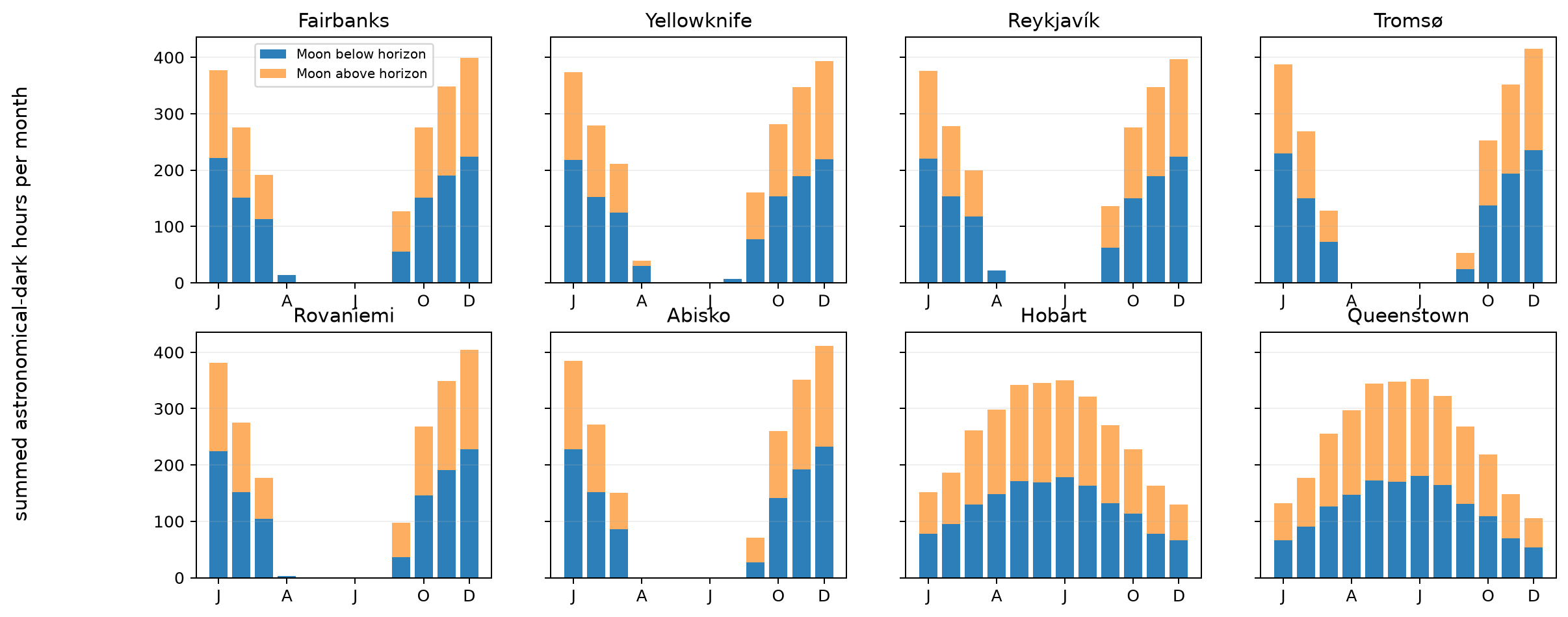
The chart below is a calculated planning reference for 2027. For every local observing night, it separates astronomical-darkness hours when the Moon’s centre was geometrically above a level horizon from hours when it was below. It does not estimate how bright the Moon appeared through atmosphere, terrain or clouds, and it does not forecast aurora activity, weather, or a successful trip.
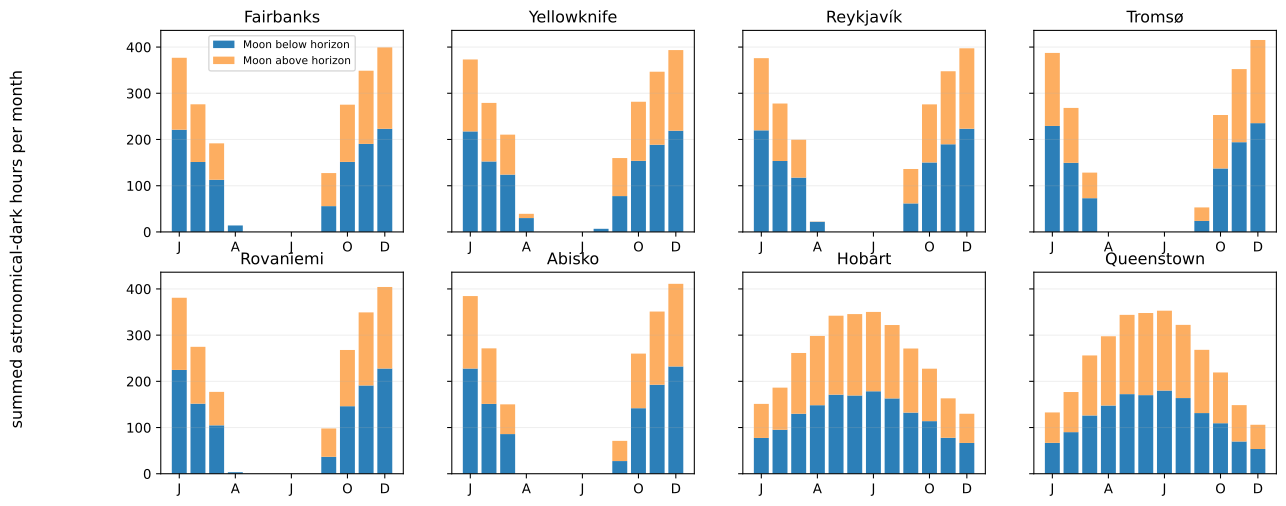
The annual totals show the different seasonal geometry rather than a destination ranking:
| City | Astronomical-darkness hours in 2027 | Moon above during darkness | Moon below during darkness |
|---|---|---|---|
| Fairbanks | 2,009.5 | 889.2 | 1,120.3 |
| Yellowknife | 2,090.3 | 920.7 | 1,169.7 |
| Reykjavík | 2,032.8 | 895.2 | 1,137.7 |
| Tromsø | 1,857.7 | 815.2 | 1,042.5 |
| Rovaniemi | 1,955.2 | 869.2 | 1,086.0 |
| Abisko | 1,899.2 | 840.3 | 1,058.8 |
| Hobart | 3,047.8 | 1,524.3 | 1,523.5 |
| Queenstown | 2,971.5 | 1,490.5 | 1,481.0 |
These values use every local noon-to-noon observing night in the calendar year; independently rounded columns can differ by 0.1 hour. The northern cities have a summer gap under the strict −18° definition; the southern pair follow the opposite seasonal pattern. For an overview of that difference, see the eight-city northern-lights calendar and the summer and twilight guide.
A full-Moon week in Yellowknife: phase is not enough
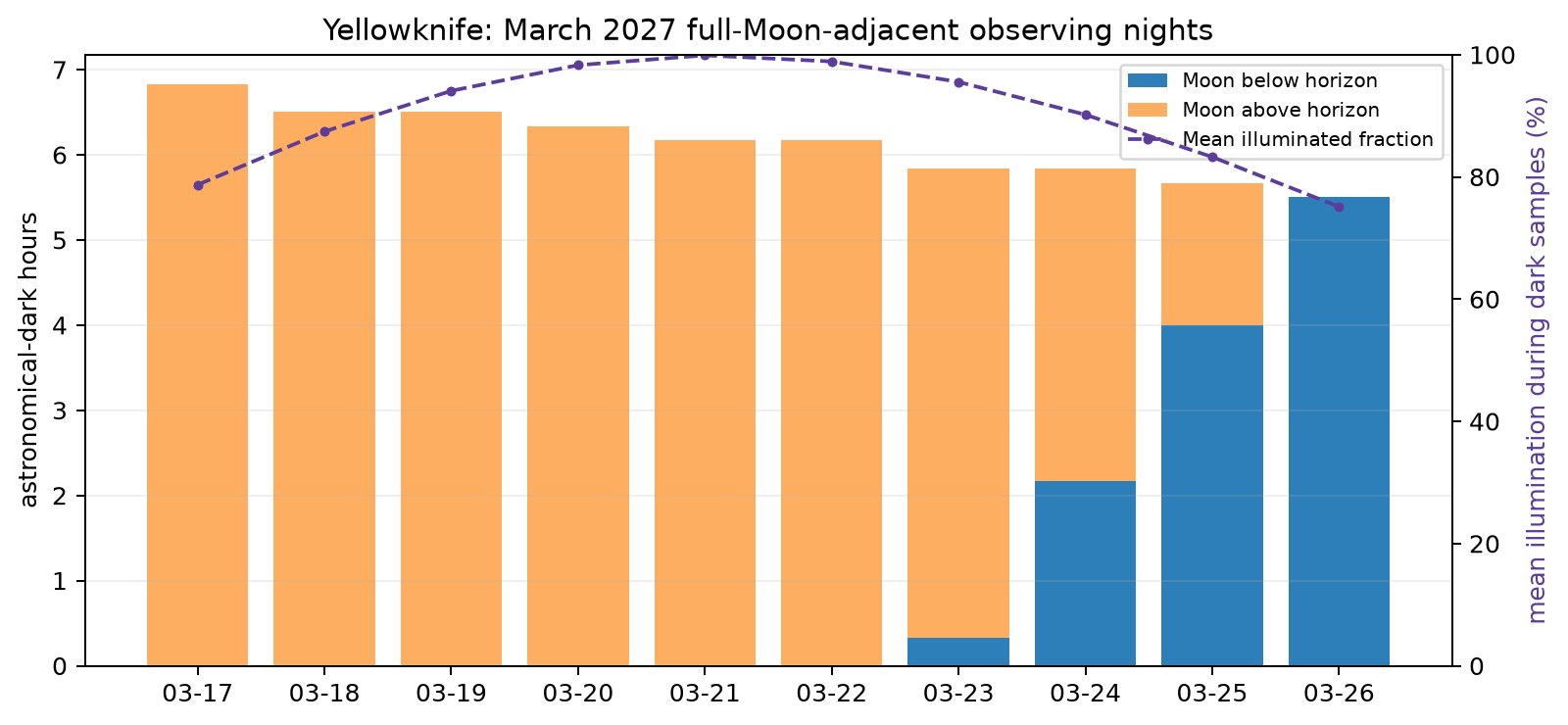
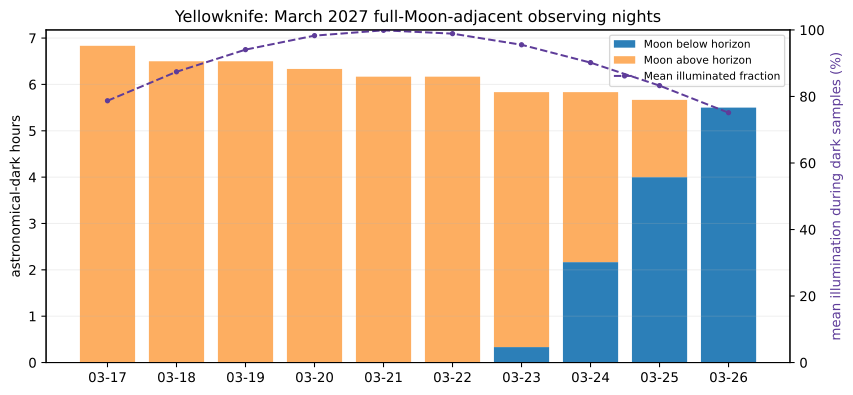
The March 2027 example makes the practical point. Skyfield calculates the full Moon at 10:43:48 UTC on 22 March; the U.S. Naval Observatory lists 10:44 UTC. The difference is only a rounding of the same instant, but the usable observing window changes through the week because the Moon rises and sets later each day.
| Observing night starts | Local ten-minute-grid dark window | Astronomical darkness | Moon above during darkness | Mean illuminated fraction during darkness |
|---|---|---|---|---|
| 21 March 2027 | 21 Mar 22:45 −06:00 to 22 Mar 04:55 −06:00 | 6.17 h | 6.17 h | 99.89% |
| 23 March 2027 | 23 Mar 22:55 −06:00 to 24 Mar 04:45 −06:00 | 5.83 h | 5.50 h | 95.54% |
| 26 March 2027 | 26 Mar 23:05 −06:00 to 27 Mar 04:35 −06:00 | 5.50 h | 0.00 h | 75.12% |
On the night starting 21 March, all 6.17 hours of strict darkness coincided with the Moon above this ideal horizon at almost full illumination. By the night starting 26 March, all 5.50 strict-dark hours had the still-bright waning gibbous Moon below it. That is a useful Yellowknife-specific example of why “avoid the full Moon” is too blunt: it describes phase, while the observing decision needs phase, horizon geometry, darkness, clouds and activity together.
The local-window CSV labels each observing night from local noon to the next local noon so that post-midnight hours belong with the preceding evening. The displayed windows are ten-minute-grid ranges, not exact rise or set times. A normal local watch may cross midnight; read both the local date and the −06:00 offset rather than treating a clock time alone as a universal schedule.
What “Moon below” does and does not mean
In this calculation, “Moon below” means the centre of the Moon was below a geometric level horizon while the Sun’s centre was below −18°. It is an idealised geometry test. It ignores atmospheric refraction, local elevation, mountains, buildings, trees and the Moon’s upper limb. It also does not measure light scattered from the atmosphere or nearby towns.
“Moon above” is not a synonym for a bright Moon. A nearly new Moon can be above the horizon with little illuminated surface. Conversely, a Moon below the geometric horizon can leave residual sky brightness near a real horizon. These limits are why the chart gives time overlap rather than a score or a visibility probability.
For photography, the same hierarchy applies. A camera can record a faint display differently from the eye, but no exposure setting can replace an open view, enough darkness and suitable activity. Use the camera guide or iPhone guide after selecting a safe location and checking the night’s live conditions.
Method and limits
This 2027 reference uses the JPL DE440s ephemeris with Skyfield and apparent topocentric centre altitudes. Lunar illumination is the physical illuminated fraction, not a linear phase proxy. The calculation samples ten-minute midpoints between local noon and the following local noon in each city’s IANA time zone. It records cumulative hours with the Sun’s centre below −6°, −12° and −18°; these are threshold-hour totals, not the durations of named twilight bands. Only the −18° threshold is used in the figures here.
The Skyfield almanac documentation, NASA’s Moon-phase guide and U.S. Naval Observatory rise/set definitions describe the astronomical concepts. This is calculated geometry for 2027, not an activity, cloud, sighting or travel-outcome forecast. Use it to understand why phase alone is incomplete, then use a current city forecast for a real night.